


.png)



aRansomware did not retreat in 2025. It restructured. According to Verizon’s 2025 Data Breach Investigations Report, ransomware was present in 44% of all analyzed breaches, up from 32% the year prior, and it appeared in a staggering 88% of breaches at small and medium businesses. Even so, Chainalysis tracked just $820 million in on-chain ransom payments for 2025, an 8% decline from 2024 and the lowest paid-rate on record at roughly 28% of victims. The picture for 2026: more attacks, fewer payers, higher costs for the organizations that get hit. This page collects the numbers IT, security, and compliance teams actually need.
Key ransomware statistics at a glance
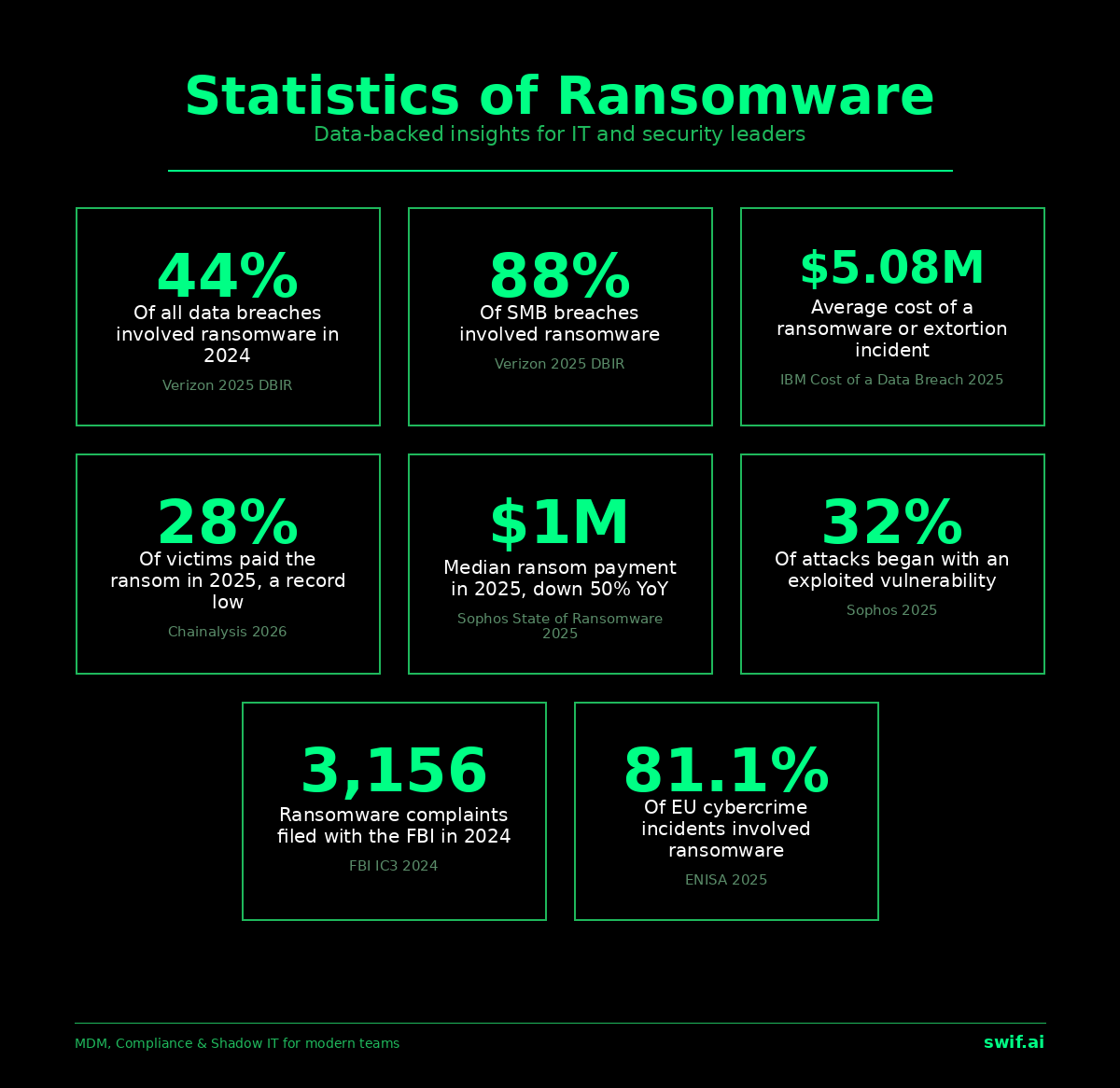
- 44% of data breaches involved ransomware in 2024, up from 32% in 2023 (Verizon 2025 DBIR).
- 88% of breaches at small and medium businesses involved ransomware, versus 39% at large enterprises (Verizon 2025 DBIR).
- $5.08 million is the average cost of a ransomware or extortion-related breach (IBM Cost of a Data Breach 2025).
- $10.22 million is the average data breach cost in the United States, the highest ever recorded (IBM 2025).
- 28% of victims paid the ransom in 2025, an all-time low (Chainalysis 2026 Crypto Crime Report).
- $1 million was the median ransom payment in 2025, down 50% from $2 million in 2024 (Sophos State of Ransomware 2025).
- 32% of ransomware attacks started with an exploited vulnerability, the most common root cause for the third year running (Sophos 2025).
- 3,156 ransomware complaints were filed with the FBI in 2024, a 9% year-over-year increase (FBI IC3 2024 Internet Crime Report).
- 81.1% of cybercrime incidents against EU organizations involved ransomware in the 12 months ending June 2025 (ENISA Threat Landscape 2025).
53% of ransomware victims recovered within a week in 2025, up from 35% in 2024 (Sophos 2025).
How often ransomware actually hits in 2026
The headline number from the Verizon 2025 Data Breach Investigations Report is a sharp jump in prevalence. Ransomware (including pure-extortion attacks without encryption) was present in 44% of analyzed breaches and 31% of all reported security incidents, more than doubling from 14% in the previous report. Verizon analyzed more than 12,000 confirmed breaches for the 2025 edition, so the trend is not a sampling artifact.
The SMB skew is even more striking. Verizon found ransomware involved in 88% of small and medium business breaches, compared with 39% at large enterprises. For an IT leader running a fleet under 500 endpoints, that means roughly nine out of ten breach events you read about in your peer group will involve some form of extortion.
In Europe, the share is even higher. The ENISA Threat Landscape 2025 report, which analyzed 4,875 incidents from July 2024 through June 2025, found that 81.1% of cybercrime incidents targeting EU organizations involved ransomware. Ransomware also accounted for 83.5% of all post-intrusion malicious code deployments observed in the region.
FBI data tells the same story from a complaint-volume angle. The 2024 IC3 Internet Crime Report logged 3,156 ransomware complaints, up 9% year over year, and ransomware was again called out as the most pervasive threat to U.S. critical infrastructure. Critical manufacturing absorbed the largest single share, reporting 258 ransomware incidents to IC3 in 2024.
Ransom payments and the cost of an attack
Two trends are pulling in opposite directions. Fewer organizations are paying, but the ones that do still pay seven figures. Chainalysis tracked roughly $820 million flowing to ransomware actors in 2025, an 8% drop from $892 million in 2024 and a 35% decline from the 2023 peak of $1.25 billion. The on-chain paid-rate has fallen to about 28%, the lowest share Chainalysis has ever recorded.
When victims do pay, the checks are large. Sophos’s State of Ransomware 2025, based on a survey of 3,400 IT and security leaders across 17 countries, reported a median ransom payment of $1 million in 2025, down 50% from $2 million in 2024 but still high by historical standards. The median demand was $1.32 million, meaning negotiators on average shaved the bill by about 24%; 53% of payers came in under the initial ask, 18% paid more, and 29% matched it exactly.
The total cost of an incident dwarfs the ransom itself. IBM’s 2025 Cost of a Data Breach Report put the average cost of an extortion or ransomware breach at $5.08 million. The global average breach cost dropped 9% to $4.44 million, but the U.S. figure climbed to $10.22 million, an all-time high, driven by regulatory fines and longer detection windows. Ransomware breaches that involved law enforcement saved roughly $1 million on average, though IBM noted that only 40% of victims contacted law enforcement in 2025, down from 52% in 2024.
Verizon’s data on the median paid amount diverges slightly because it includes more SMB cases. The 2025 DBIR reports a median ransom payment of $115,000 for 2024, down from $150,000 the year before, and notes that 64% of victim organizations did not pay at all, up from 50% two years prior.
How ransomware actors are getting in
For the third consecutive year, exploited vulnerabilities are the most common entry point. Sophos 2025 found 32% of ransomware incidents began with an exploited software vulnerability, and those incidents were the most damaging. Attacks that started with an unpatched vulnerability led to backup compromise 75% of the time and resulted in a ransom payment 71% of the time, both well above the average.
Compromised credentials remained the second most common vector at 23% of attacks, down from 29% in 2024. Email-based entry still accounts for a meaningful share: malicious emails were the initial vector in 19% of cases, and phishing in 18%. Inside those numbers, the operational story is consistent. Identity, endpoint hygiene, and patch latency are still the controls that decide whether an intrusion becomes a ransomware event.
Organizational gaps matter too. Sophos survey respondents cited lack of in-house expertise (42.5%) and unknown security gaps (41.6%) as the leading internal contributors to a successful attack. For IT teams managing a fleet without dedicated security headcount, those numbers underline why automated device management and compliance posture controls matter as much as detection tooling.
Sector breakdowns: who is getting hit hardest
Healthcare keeps drawing attention, but the underlying numbers have shifted. The State of Ransomware in Healthcare 2025 from Sophos found that median ransom demands against healthcare organizations plummeted 91% year over year to $345,000, and median payments fell to just $150,000, the lowest across all surveyed sectors. Only 36% of healthcare providers paid the ransom in 2025, down from 61% in 2022. 58% recovered within a week, suggesting that backup and incident response investments are starting to pay off in clinical environments.
Manufacturing has become the headline target in Europe. ENISA reports that 14.9% of all ransomware claims in the EU during the 12 months ending June 2025 targeted manufacturing, the largest single sector share. Sophos manufacturing-specific data showed that 58% of manufacturers fully recovered within a week, up from 44% the year prior, while attackers shifted toward data theft over encryption.
U.S. critical infrastructure remains the FBI’s top concern. The IC3 2024 report logged more than 4,800 incidents affecting critical infrastructure entities, with critical manufacturing, healthcare, and government facilities leading. The top five active ransomware groups in 2024 were Akira, LockBit, RansomHub, FOG, and PLAY, and IC3 cataloged 67 newly observed variants during the year.
Emerging trends and what is new in 2026
Extortion-only attacks are the fastest-growing variant. Sophos 2025 reported that data theft without encryption tripled to 12% of attacks in 2025, up from 4% in 2022. For affected organizations, this means the recovery playbook (restore from backup, rebuild endpoints) does not eliminate the leverage attackers hold. Sensitive data is already out the door, and disclosure obligations under U.S. state laws, HIPAA, GDPR, and the SEC’s cyber disclosure rule still apply.
Initial access is getting cheaper. Chainalysis tracked the average price of victim access on underground markets falling from roughly $1,427 in Q1 2023 to $439 in Q1 2026, a 69% drop in three years. Lower prices and more automation mean the cost of an attempted attack is collapsing, even as the share of paying victims declines.
The median demand fell, but per-victim demands are now far more variable. Chainalysis saw the median paid ransom across its tracked transactions surge 368% year over year to nearly $60,000, while Sophos enterprise data showed median demands of $1.20 million. The takeaway: small-business demands have come down to commodity levels (low five figures, sometimes negotiated lower still), while enterprise demands remain in the seven-figure band, often coupled with data theft pressure.
AI-driven defenses are starting to show up in the loss column. IBM’s 2025 report attributed the 9% decline in global average breach cost to broader use of AI and automation in detection and containment, the first such decline in five years. The flip side: shadow AI tooling created its own breach pathway, with breaches involving unsanctioned AI usage adding measurable cost.
Third-party and supply chain compromises are the second most frequent attack vector in IBM’s 2025 data at 15% of incidents, and they took the longest to detect and contain (267 days on average). For organizations that depend on tightly controlling unsanctioned SaaS and AI tools, the implication is direct: shadow IT and unmanaged third-party access are now a primary ransomware enabler, not a peripheral concern.
Recovery speed is the bright spot. Sophos reports that 53% of ransomware victims fully recovered within a week in 2025, up from 35% in 2024, and the share of attacks stopped before encryption more than doubled in two years, from 22% in 2023 to 47% in 2025. The percentage of victims relying on backups for recovery, however, fell to a five-year low of 54%, which suggests organizations are leaning more on incident response and forensics partners than on cold storage alone.
For broader context on the trends above, see our malware statistics and data breach statistics roundups.
How swif.ai helps IT and security teams reduce ransomware exposure
swif.ai gives IT and security teams a single console to enforce device, identity, and compliance controls across the macOS, Windows, and Linux endpoints behind the numbers above. Explore swif.ai unified endpoint management to see how it works.
If you are looking for more detailed Cybersecurity statistics, check out our detailed article here.



.webp)