


.png)



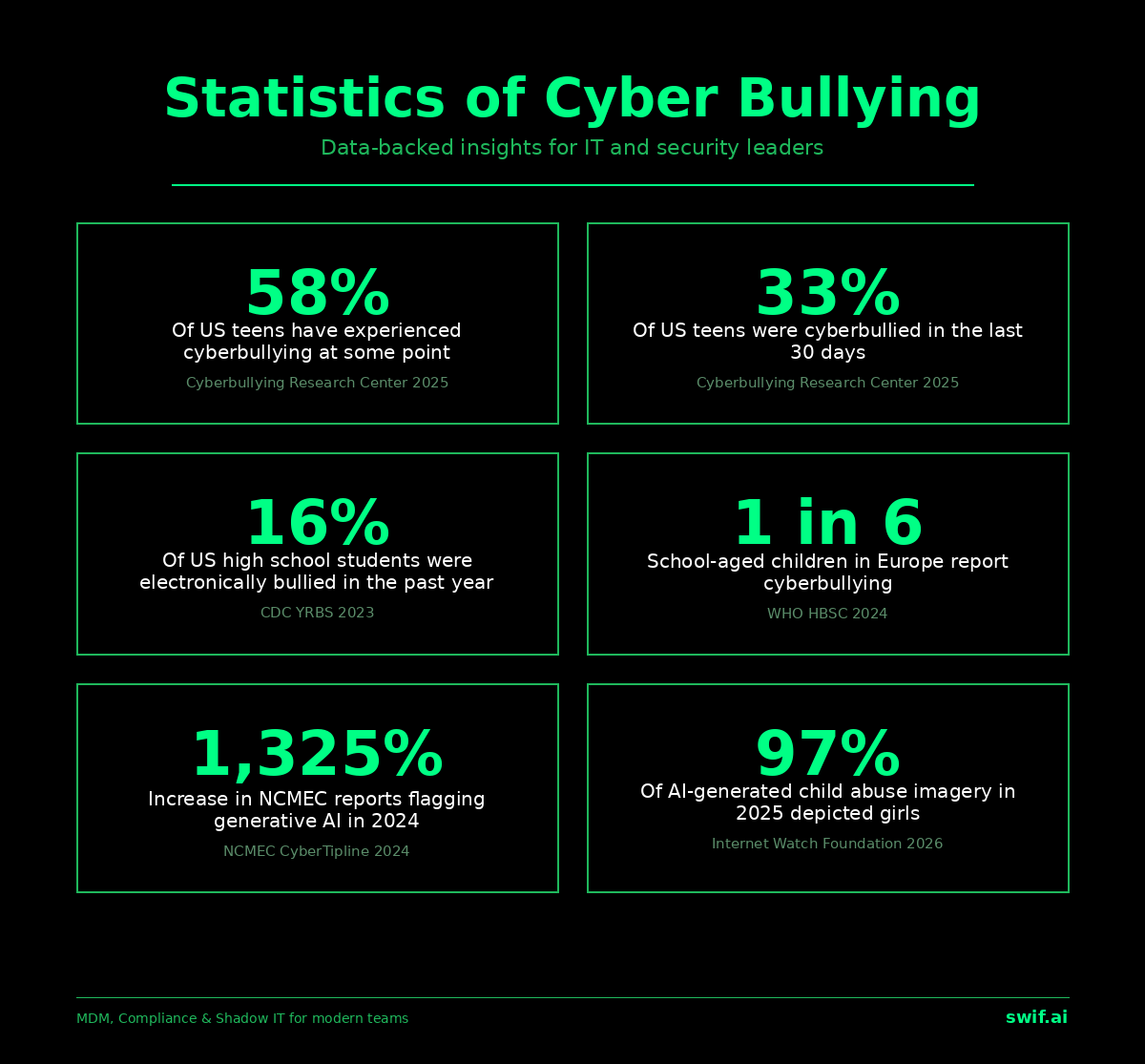
More than half of US teens have been cyberbullied at some point in their lives, and roughly one in three were targeted in the last 30 days alone. According to the Cyberbullying Research Center's 2025 national survey of 3,466 middle and high school students, lifetime cyberbullying victimization reached 58% and past-30-day victimization reached 33%, the highest figures the center has recorded in nearly two decades of measurement. The US Centers for Disease Control and Prevention finds that 16% of US high school students were electronically bullied in the past year, and the WHO HBSC 2024 study puts the European figure at the same one-in-six mark. Below is what the 2025 and 2026 data say about who gets targeted, where it happens, and how fast AI is reshaping the landscape.
If you are requiring for more detailed cybersecurity statistics, review our detailed article here.
Summary: Key Cyber Bullying Statistics at a Glance
- 58% of US teens have experienced cyberbullying at some point in their lives, per the Cyberbullying Research Center's 2025 survey.
- 33% of US teens were cyberbullied in the previous 30 days, the highest 30-day rate the center has measured.
- 16% of US high school students reported being electronically bullied in the past year, per the CDC's 2023 Youth Risk Behavior Survey.
- 25% of LGBTQ+ high school students reported electronic bullying, compared with 20% of their white peers, in the same CDC survey.
- 16% of school-aged children in 44 European, Central Asian, and Canadian regions have experienced cyberbullying, per the WHO HBSC 2024 report.
- 22% of US students who were bullied at school in 2021-22 said the bullying happened online or by text, per the NCES Condition of Education 2024.
- ~30% of teen Snapchat users have been called offensive names, had rumors spread about them, or been physically threatened on the platform, compared with about one in five for Instagram or TikTok, per Pew Research Center's April 2026 survey.
- 20.5 million child sexual exploitation reports were received by the NCMEC CyberTipline in 2024, including a 1,325% surge in reports involving generative AI.
97% of AI-generated illegal child sexual abuse imagery assessed in 2025 depicted girls, per the Internet Watch Foundation's 2026 AI CSAM Report.
How widespread is cyber bullying in 2026?
The Cyberbullying Research Center's 2025 national survey, conducted in May 2025 with a nationally representative sample of US teens ages 13 to 17, found that 58% have been cyberbullied at some point in their lives and 33% were targeted in just the previous month. Both figures are the highest the center has recorded since it began measuring in 2007. About 24.5% of teens also admitted to cyberbullying someone else at some point, and 16.1% had done so in the past 30 days.
The most common forms reported by victims in the past 30 days were being excluded from a text or group chat (32.5%), receiving mean or hurtful comments online (31.6%), being embarrassed or humiliated online (31.3%), and having rumors spread about them online (29.2%). Exclusion from group chats is now the single most-reported form of cyberbullying, which is a notable shift away from the older "mean comments" framing that dominated earlier survey years.
The CDC's 2023 Youth Risk Behavior Survey, the largest federally sponsored survey of US high school students, found that 16% of high schoolers had been electronically bullied in the past year, including through texting, Instagram, Facebook, or other social media. The CDC survey uses a narrower 12-month window than the Cyberbullying Research Center's lifetime measure, which is the main reason the two prevalence figures differ. The two surveys agree on direction: cyberbullying rates have not declined since the pandemic and may be trending up.
School-level data from the federal National Center for Education Statistics' Condition of Education 2024 shows that 19% of students ages 12 to 18 were bullied at school in 2021-22, down from 28% in 2010-11. Among the students who reported being bullied, 22% said the bullying happened online or by text, which means traditional and digital bullying continue to overlap rather than replace each other.
Who gets targeted: gender, sexual orientation, and age
The 2025 Cyberbullying Research Center data reports a striking departure from a decade of US findings: adolescent boys are now more likely than girls to experience cyberbullying both as targets (36.6% versus 28.6%) and as aggressors (21.7% versus 10.4%), with both differences statistically significant at p < .001. Hinduja and Patchin, the center's co-directors, note that this represents a change from most of their previous research, which had found boys and girls equally likely to be targeted. The shift may reflect changes in how boys and girls use group messaging and gaming platforms, but it is too early to call it a durable trend.
The CDC's 2023 YRBS reports a different pattern at the population level: female high school students were more likely than male students to experience both in-school and electronic bullying. The CDC also found significantly higher rates among LGBTQ+ students, with 25% reporting electronic bullying compared with around 20% among non-LGBTQ+ peers. The mental health overlay is severe. The same CDC analysis found that adolescents who reported frequent social media use were more likely to be bullied, more likely to feel persistently sad or hopeless, and more likely to seriously consider suicide.
Across Europe, Central Asia, and Canada, the WHO HBSC 2024 study of more than 279,000 adolescents found that cyberbullying victimization peaked at age 11 for boys and age 13 for girls. Roughly 16% of adolescents had been cyberbullied and about 12% (one in eight) had cyberbullied others. The study also found that while school bullying trends have stayed flat since 2018, cyberbullying has risen, which the WHO attributes to the deepening digitalization of young people's interactions.
Where it happens: platforms and forms
Pew Research Center's April 2026 report on teens' experiences across TikTok, Instagram, and Snapchat is the freshest US picture of platform-level harassment. Surveying 1,458 US teens ages 13 to 17 in late 2025, Pew found that roughly three in ten Snapchat users have been called offensive names, had rumors spread about them, or been physically threatened on the platform. The same shares drop to roughly one in five for Instagram or TikTok. Across all three platforms, about three-quarters of teen users say harassment and bullying on the site is a problem for people their age.
Pew also found that teen TikTok users are most likely to say the app hurts their sleep and productivity (roughly four in ten report sleep loss), while Snapchat users are most likely to say messaging happens daily (57%) and to post on the platform multiple times a day (17%). The intensity of use lines up with the elevated harassment rates that Pew reports for Snapchat.
The form of cyberbullying matters for response. Exclusion from group chats, the most common form in the 2025 Cyberbullying Research Center data, is harder for parents, teachers, and platforms to detect than direct hostile messages, because the offense is the absence of access rather than the presence of harmful content. The same survey shows that more than three in ten victims also report being embarrassed or humiliated publicly, which often plays out through screenshots, edited images, or short videos shared in semi-private group threads where school administrators have little visibility.
How cyber bullying compares globally
The European picture in the WHO HBSC 2024 report tracks closely with the US. About one in six 11-, 13-, and 15-year-olds in 44 countries and regions had experienced cyberbullying. Boys were more likely to report perpetrating violence both at school and online (8% versus 5% for school bullying), and roughly 11% of adolescents reported being bullied at school. The WHO data, drawn from over 279,000 young people, is the largest cross-national adolescent dataset in the world and is updated every four years.
A notable WHO finding for school IT and safety leaders: in countries where cyberbullying rose sharply between 2018 and 2022, school bullying did not fall in tandem. That is consistent with the picture from the US NCES Condition of Education 2024: digital bullying is additive to school bullying, not a substitute for it.
Emerging trends: AI deepfakes and what is new in 2026
The fastest-moving piece of the 2025 and 2026 cyberbullying landscape is AI-generated image abuse. The National Center for Missing and Exploited Children's 2024 CyberTipline data shows that reports flagging generative AI as a component of the abuse climbed from 4,700 in 2023 to 67,000 in 2024, a 1,325% increase. NCMEC received 20.5 million total child sexual exploitation reports in 2024. While the headline number was lower than 2023's 36.2 million, the AI-flagged subset grew sharply, and NCMEC has cautioned that incidents involving AI are still significantly underreported because many platforms have only recently added a generative AI checkbox to their reporting workflows.
The Internet Watch Foundation's 2026 AI CSAM Report finds an even steeper trajectory for video. IWF analysts identified 3,443 AI-generated child sexual abuse videos in 2025, compared with 13 in 2024, a 260-fold increase. Sixty-five percent of those videos were classified as Category A, the most severe classification. The gender skew is extreme. Across all AI-generated child abuse imagery the IWF assessed in 2025, 97% of victims were girls.
That trend has begun to reach mainstream schools. US K-12 districts in 2025 reported a wave of incidents in which students used freely available "nudify" apps to fabricate explicit images of classmates, almost always female classmates, and circulated them in group chats and on social media. Districts have responded with criminal referrals and, in some cases, by removing student photographs from public-facing school websites. The combination of group-chat exclusion (the most common form of conventional cyberbullying in 2025) and AI-fabricated imagery (the fastest-growing form of online child abuse) means schools are now dealing with two qualitatively different problems on the same fleet of devices.
What the 2026 data implies for schools and IT teams
Three patterns stand out for IT, security, and safety leaders heading into the 2026-27 school year. First, the prevalence numbers in the 2025 Cyberbullying Research Center data are the highest on record, which suggests that the post-pandemic shift toward continuous social-media access has not corrected itself. Second, the dominant form of cyberbullying has migrated from public posts to private and semi-private group chats, where filtering and monitoring tools designed for public web content miss the activity entirely. Third, AI-generated abuse imagery is now appearing inside schools at a pace that traditional digital citizenship curricula were not built to address.
For schools running 1:1 device programs, the practical implication is that device policy, app management, and monitoring need to cover messaging, image generation, and AI tool usage on every school-managed device, not just web browsing.
How swif.ai helps schools reduce cyber bullying exposure
For broader context on the digital safety trends behind these numbers, see our security awareness training statistics and social engineering statistics roundups.
swif.ai gives K-12 IT teams a single console to enforce device, app, and content policies across the macOS, Windows, ChromeOS, and iPadOS endpoints that students use every day. Pre-built policy templates restrict access to known nudify and deepfake generation tools, surface unsanctioned AI app usage on school-issued devices, and give administrators a clear audit trail when incidents happen. Explore swif.ai's MDM for Education to see how it works.




.webp)