


.png)



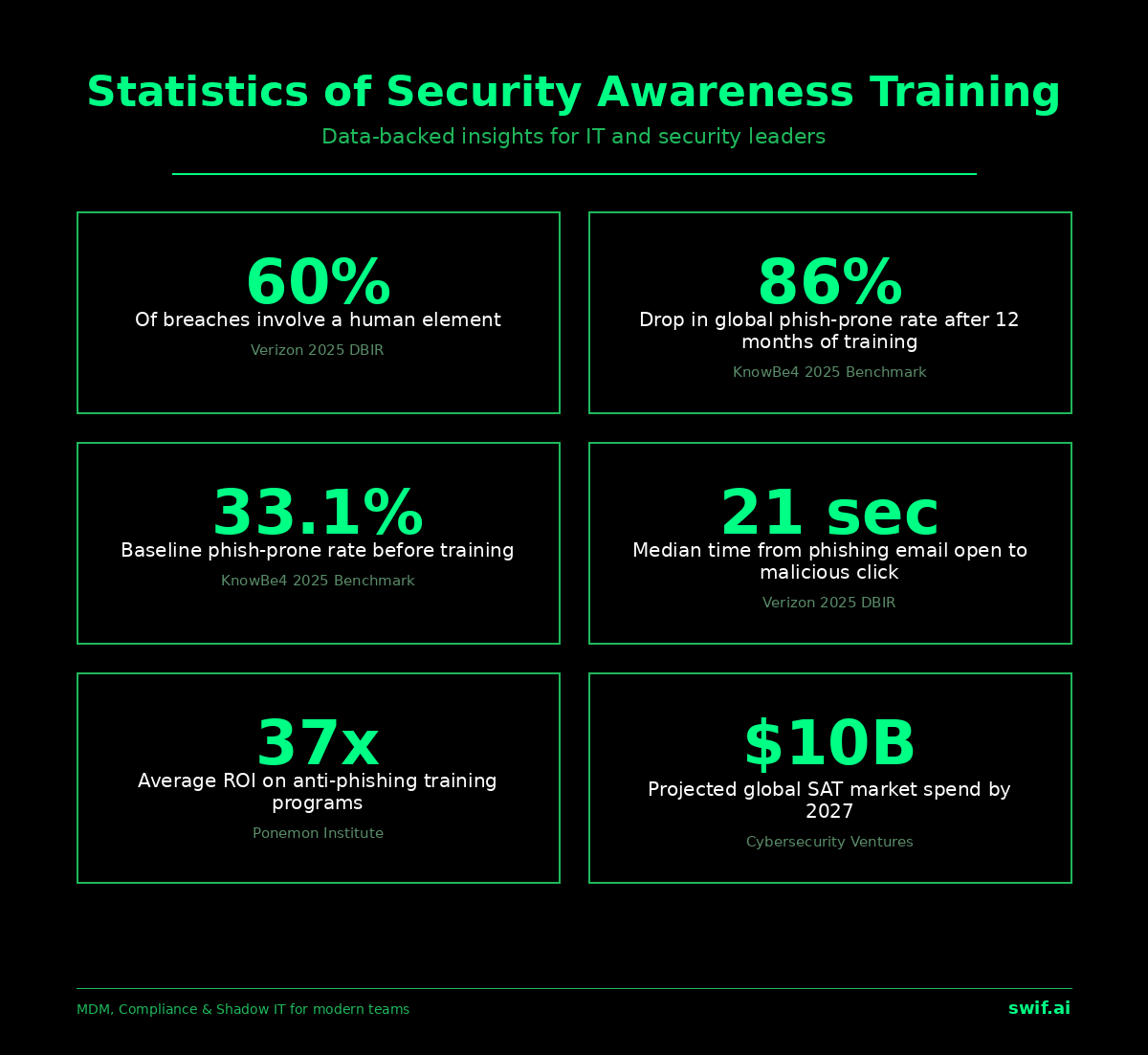
Security awareness training is no longer a check-the-box compliance line item, and the 2025 to 2026 data finally reflects that. Twelve months of continuous training cut the global phish-prone rate by 86%, dropping organizations from a 33.1% baseline to just 4.1%, according to the KnowBe4 2025 Phishing by Industry Benchmarking Report. Yet the human element is still involved in roughly 60% of breaches worldwide, per the Verizon 2025 Data Breach Investigations Report, and the median time between a phishing email being opened and a user clicking the malicious link is just 21 seconds. The training works when it sticks, and the gap between programs that produce real behavior change and those that do not is widening as AI reshapes both the attack and the defense.
Summary: key security awareness training statistics at a glance
- 60% of breaches involve a human element, holding steady year over year (Verizon, 2025).
- 33.1% is the global baseline phish-prone percentage before any security awareness training (KnowBe4, 2025).
- 86% drop in the global phish-prone rate after 12 months of training, taking it down to 4.1% (KnowBe4, 2025).
- 40% reduction in phishing susceptibility appears within just 90 days of starting training (KnowBe4, 2025).
- 21 seconds is the median time between a phishing email being opened and a malicious link being clicked (Verizon, 2025).
- 37x is the average one-year ROI on anti-phishing training programs, per a Ponemon Institute study.
- 41.9% baseline phish-prone rate in Healthcare and Pharmaceuticals, the highest of any sector (KnowBe4, 2025).
- $10 billion projected global security awareness training market spend by 2027, up from $5.6 billion in 2023 (Cybersecurity Ventures).
2.8 FTEs is the minimum staffing required to shift user behavior at scale, per the SANS 2025 Security Awareness Report.
The human factor: why training has to work
Defenders cannot patch their way out of the human factor. The Verizon 2025 Data Breach Investigations Report, which analyzed more than 22,000 incidents and 12,195 confirmed breaches, found that the human element remains involved in roughly 60% of breaches worldwide. Phishing was the initial access vector in 16% of breaches, credential abuse in 22%, and stolen credentials underpinned 88% of basic web application attacks.
The speed of the modern phishing kill chain is what makes training the only practical control. Verizon’s simulation data showed a median click time of 21 seconds between phishing message open and malicious link click, with the user typically submitting credentials within another 28 seconds (Verizon, 2025). That window is too short for any tooling-based remediation to catch up. By the time a SOC analyst sees the alert, the credentials are already in an attacker’s session token. Awareness training is what determines whether the click happens at all.
The bigger context also matters for budget conversations. According to IBM’s 2025 Cost of a Data Breach Report, employee security training is on the short list of proven cost mitigators alongside DevSecOps, AI-driven security insights, and incident response planning. Organizations that experience a breach overwhelmingly cite training as a top post-incident investment, with 51% of breached organizations increasing security spend the following year and naming employee training as one of the leading targets for that spend.
How effective is security awareness training in 2026?
The most cited number in this category comes from KnowBe4’s annual benchmarking work. The 2025 Phishing by Industry Benchmarking Report analyzed 67.7 million phishing simulations across 14.5 million users in more than 62,000 organizations. Before any training, the global average phish-prone percentage stood at 33.1%, meaning roughly one in three employees would click on a simulated phishing link. After 90 days of consistent training, that rate fell by about 40%. After 12 months of continuous training, the global phish-prone rate dropped 86% to 4.1%.
Improvements are even sharper in specific sectors. Among organizations of 1,000 to 9,999 employees, three sectors hit 91% phish-prone improvement after 12 months of training: Healthcare and Pharmaceuticals, Hospitality, and Legal (KnowBe4, 2025). That same report flagged Healthcare and Pharmaceuticals as the riskiest sector before training, with a 41.9% baseline phish-prone rate, followed by Insurance (39.2%) and Retail and Wholesale (36.5%). Bigger companies start in a worse position too: organizations with 10,000-plus employees averaged a 40.5% baseline rate, against 24.6% for organizations of 1 to 250 employees.
Behavior-change-led programs are pulling further ahead of legacy classroom training. Research from the SANS 2025 Security Awareness Report, which surveyed more than 2,700 security professionals across 70 countries, found that programs designed around behavior change (rather than knowledge transfer) consistently report higher reductions in real-world phishing reports and faster threat reporting rates. SANS also identified microlearning, delivered automatically within 24 hours of a failed simulation, as one of the highest-leverage program design choices an organization can make, because in-the-moment feedback produces stronger behavioral retention than scheduled refreshers.
The ROI of security awareness training
Few security investments produce as much measurable financial return as awareness training. The widely cited Ponemon Institute study on anti-phishing training found an average one-year ROI of 37 times the program cost, even after accounting for productivity loss during training time. For organizations using more advanced platforms, the same study reported up to a 50x ROI, driven primarily by avoided phishing incident costs. Ponemon’s model assumed total annual phishing costs of $3.77 million per organization, with a 48% reduction in successful phishing producing roughly $1.80 million in annual savings.
The market is responding to those returns. Cybersecurity Ventures projects that global security awareness training spend will reach $10 billion annually by 2027, up from approximately $5.6 billion in 2023, on roughly 15% year-over-year growth. For context, Gartner pegged the same market at around $1 billion in 2014. Few categories within the security stack have grown ten-fold in a decade.
On the avoided-cost side, the math is straightforward. The IBM Cost of a Data Breach Report 2025 put the global average breach cost at $4.44 million, with US organizations averaging $10.22 million per breach. A program that costs $50,000 to $250,000 a year and reduces a single mid-size breach probability by even a single percentage point pays for itself many times over.
Frequency, formats, and role-based training
Frequency is the single biggest predictor of program success. KnowBe4’s benchmarking data shows that phish-prone rates only continue to fall when training is reinforced quarterly or more often; programs that train annually see initial gains plateau and rebound within 12 to 18 months (KnowBe4, 2025). The 86% improvement number quoted earlier assumes ongoing, not one-and-done, training.
SANS’ 2025 maturity analysis found that programs reach the "behavior change" tier of the SANS Security Awareness Maturity Model only when they devote at least 2.8 full-time equivalents to the function (SANS, 2025). Reaching the "sustainable culture" tier typically requires four or more FTEs sustained over five to ten years. Most programs that under-resource the function (a single part-time owner shared with another role) stagnate at the "compliance focused" tier and miss the behavior-change payoff entirely.
Format also matters. Microlearning modules in the 2- to 5-minute range, delivered just after a simulation failure or just before a relevant risk event, outperform 30- to 60-minute annual sessions on retention and behavior metrics (SANS, 2025). Gamified leaderboards, points-based reinforcement, and role-based content paths (executives, developers, finance, customer service) round out modern program design. SANS notes that role-based training is particularly important for high-risk roles, including finance teams targeted by business email compromise and developers targeted by repository-credential phishing.
Emerging trends: what is new in 2026
AI is the single biggest disruptor on both sides of the training equation. The World Economic Forum’s Global Cybersecurity Outlook 2026 surveyed more than 1,200 cyber leaders and found that AI-driven attacks now sit at the top of the CISO threat priority list for the first time. The same report noted that more than half of CEOs outside Europe and North America admit they lack the skills to hit current cybersecurity goals, with sub-Saharan Africa (70%) and Latin America and the Caribbean (69%) facing the steepest gaps, conditions that put even greater weight on awareness training as a low-cost, scalable defense.
On the attacker side, AI is industrializing the phishing economy. Independent simulations show that AI-generated phishing emails now match or exceed the click rates of expert human attackers, and AI-generated voice and video deepfakes are climbing fast in the threat-actor toolkit (WEF, 2026). For training programs, that means simulation content must now include AI-generated lures, deepfake voice scenarios (vishing), and SMS-based attacks (smishing), not just classic email phishing.
Defenders are using AI in turn. The IBM Cost of a Data Breach Report 2025 found that organizations using extensive security AI and automation saved an average of $1.9 million per breach. Several major training platforms now use AI to personalize simulation content to individual users’ click history, role, and risk profile, producing per-employee training paths instead of one-size-fits-all annual modules. Early data suggests these adaptive approaches cut malicious-click rates faster than static training (referenced in SANS, 2025).
Government guidance is converging on the same direction. The US Cybersecurity and Infrastructure Security Agency now lists workforce training as a foundational defensive control in its #StopRansomware guidance and runs the Federal Cyber Defense Skilling Academy, a 12-week cohort program for federal employees that produced its largest graduating class to date in fiscal 2025. CISA’s public-facing materials emphasize ongoing, role-aware training over annual compliance exercises, mirroring what private-sector programs are now doing.
The behavior-change gap
Even with the numbers above, the picture is not uniformly positive. The SANS 2025 Security Awareness Report surfaced a persistent maturity gap: most programs still sit at the "compliance focused" or "promoting awareness" tier rather than at the behavior-change or culture tiers where the largest risk reductions occur. Awareness alone, the SANS data shows, does not translate to behavior. People who know they should not click still do, especially under time pressure or when phishing lures personalize against current work context.
Two structural issues drive that gap. First, under-investment: programs that operate at less than one full-time equivalent rarely move beyond compliance training. Second, the disconnect between security teams and employees on what actually works. As IBM has noted in successive Cost of a Data Breach editions, training combined with simplified, friction-light security controls (single sign-on, passwordless authentication, well-placed phishing warning banners) produces larger behavior shifts than either approach alone. The takeaway for 2026 program design: training is necessary but not sufficient. It pays back when paired with controls that make the secure path the easy path.
For broader context on the trends above, see our phishing statistics and social engineering statistics roundups.
How swif.ai helps reduce human-driven risk
swif.ai gives IT and security teams a single console to enforce device, identity, and compliance controls across the macOS, Windows, and Linux endpoints behind the numbers above. Explore swif.ai unified endpoint management to see how it works.
If you are looking for more detailed Cybersecurity statistics, check out our detailed article here.



.webp)