


.png)



Financial services entered 2026 as the most attacked industry on the internet by several measures, and the most expensive to defend in regulatory terms. The average cost of a data breach in the financial sector reached $5.56 million in 2025, second only to healthcare, according to the IBM Cost of a Data Breach Report 2025. Banks and payment platforms now absorb 34% of all observed Layer 3 and 4 DDoS attacks, per Akamai. Two thirds of financial services organizations were hit by ransomware in the latest measurement period, per Sophos. And the share of breaches involving a third party has doubled to 30% across all industries, an especially sharp signal for finance given how deeply banks rely on cloud, payments, and fintech partners. These are the financial services cybersecurity statistics IT, security, and compliance leaders need to know going into 2026.
Key financial services cybersecurity statistics at a glance
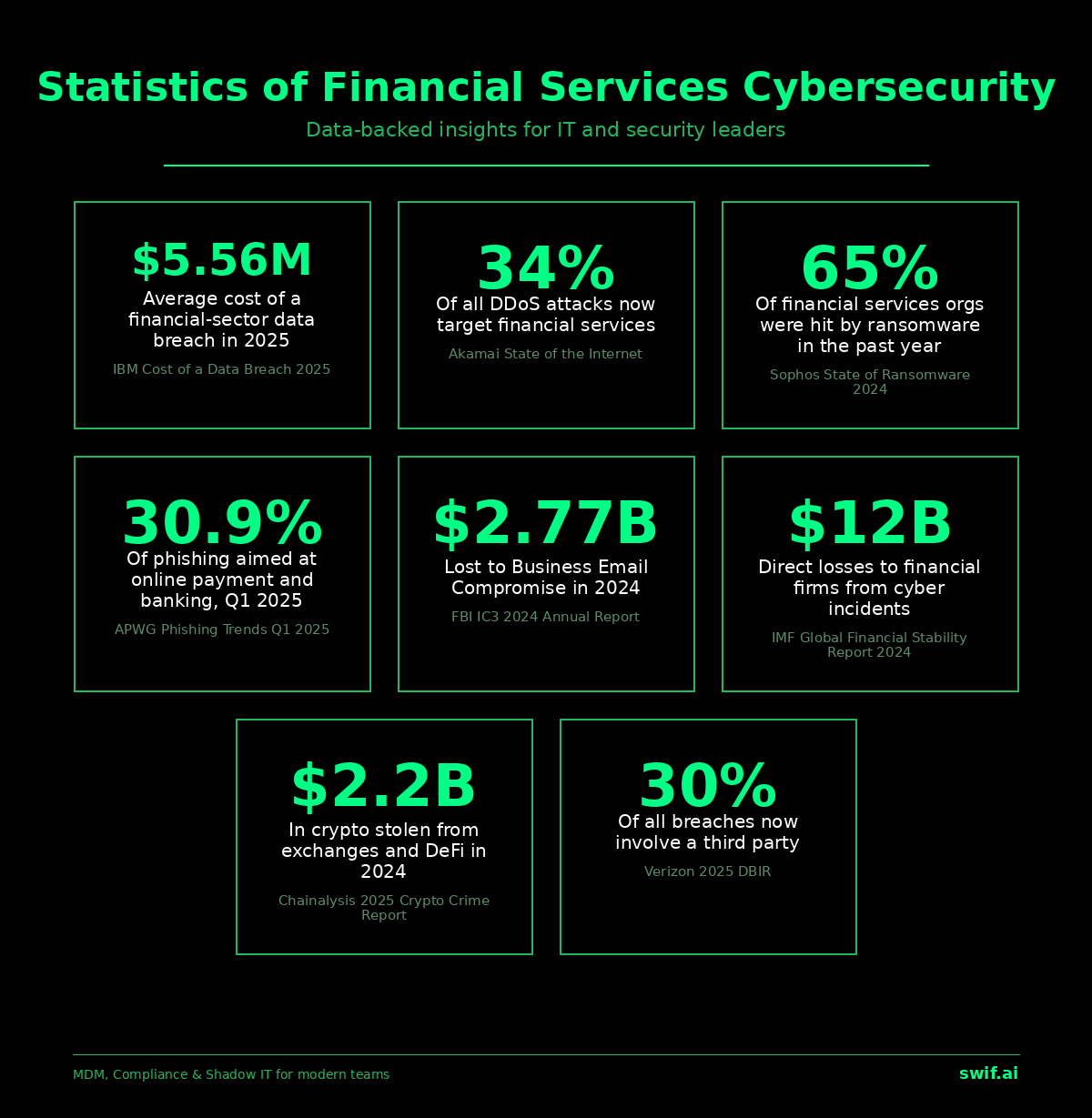
- $5.56 million was the average cost of a financial-sector data breach in 2025, the second-most expensive industry tracked, per the IBM Cost of a Data Breach Report 2025. The global cross-industry average was $4.44 million.
- 34% of all Layer 3 and 4 DDoS attacks targeted financial services, the most of any industry for the second straight year, per Akamai's State of the Internet. The median attack duration against finance has surged 738% since 2024.
- 65% of financial services organizations were hit by ransomware in the past year, with mean recovery costs of $2.58 million, per Sophos State of Ransomware in Financial Services 2024.
- 30.9% of all phishing attacks targeted online payment and banking institutions in Q1 2025, per the APWG Phishing Activity Trends Report. Adding crypto wallets and exchanges pushes the share to roughly 33%.
- $2.77 billion was lost to Business Email Compromise in 2024 alone, per the FBI Internet Crime Complaint Center 2024 Annual Report. Total cybercrime losses reached $16.6 billion, up 33% year over year.
- $12 billion in direct losses have hit the global financial sector from cyber incidents over the last two decades, with the size of extreme losses quadrupling since 2017 to $2.5 billion, per the IMF Global Financial Stability Report.
- $2.2 billion in crypto was stolen from exchanges, custodians, and DeFi protocols in 2024, with North Korea-linked actors taking $1.34 billion (61% of the total), per the Chainalysis 2025 Crypto Crime Report.
- 30% of all data breaches now involve a third-party vendor, double the prior year and a critical metric for an industry built on partner ecosystems, per the Verizon 2025 Data Breach Investigations Report.
44% of confirmed breaches across all industries involved ransomware in 2024, up from 32% a year earlier, per Verizon. Credential abuse remains the leading initial access vector at 22%.
The cost of a financial sector breach in 2025
Financial services has been the second most expensive industry to breach for more than a decade. According to the IBM Cost of a Data Breach Report 2025, the average financial-sector incident cost $5.56 million, $1.12 million above the cross industry average of $4.44 million. The premium is structural. Banks, broker-dealers, and insurers carry regulatory disclosure obligations under the New York Department of Financial Services 23 NYCRR 500, the Federal Trade Commission Safeguards Rule, GLBA, the SEC cyber disclosure rule, and (in the EU) the Digital Operational Resilience Act. Each adds notification, audit, and remediation cost on top of the technical response.
The same IBM research underscores why detection speed matters. Across all industries the average breach lifecycle was 241 days in 2025, and every day attackers remain inside a network multiplies the volume of records exposed and the operational impact. For financial services that translates into multi state notification requirements, frozen transactions, and customer churn that no SOC budget on its own can absorb. The 2025 report also flagged a new line item: $670,000 in additional cost when shadow AI tools were involved in the breach, a figure especially relevant for banks experimenting with generative AI in customer-facing flows.
Ransomware in banking, fintech, and insurance
Ransomware remains the dominant operational threat. Per the Sophos State of Ransomware in Financial Services 2024 report, 65% of financial services organizations surveyed were hit by ransomware in the prior year, holding near the 64% rate reported the year before. The mean cost to recover (excluding the ransom itself) was $2.58 million, up from $2.23 million the year prior. 51% of victims paid the ransom to get their data back, but 62% restored from backups, showing that resilient backup strategies remain the most reliable lever finance teams control.
The Sophos State of Ransomware in Financial Services 2025 update found that data encryption hit 59% of attacked organizations in financial services, above the cross industry average of 50%. The encryption rate matters because encryption is the moment a breach becomes an operational outage; for a bank, that can mean ATMs offline, wire systems frozen, or payment processors unable to clear. Across the broader industry data, Verizon's 2025 Data Breach Investigations Report found that ransomware appeared in 44% of all confirmed breaches in 2024, up from 32% the year before. The median ransom payment was $115,000, but 64% of victims paid nothing, up from 50% two years earlier, a sign that the negotiating leverage is shifting toward defenders.
Phishing and Business Email Compromise: the wire-fraud problem
Phishing remains the single most popular path into a financial institution because it bypasses every firewall and EDR control by targeting the human. According to the APWG Phishing Activity Trends Report for Q1 2025, attacks against online payment and banking sectors together accounted for 30.9% of all observed phishing in the first quarter. Adding cryptocurrency targets (wallets, exchanges, and DeFi protocols) brings the share of finance-related phishing to roughly 33% of global volume. APWG logged 1,003,924 phishing attacks in Q1 2025, the largest quarterly volume since late 2023.
The financial damage of phishing concentrates in Business Email Compromise. The FBI IC3 2024 Annual Report recorded $2.77 billion in BEC losses across 21,442 complaints in 2024, with cumulative BEC losses topping $8.5 billion from 2022 through 2024. BEC ranked second on the dollar-loss list of all internet crime categories, behind only investment fraud. Total IC3 losses reached $16.6 billion in 2024, up from $12.5 billion the year before, and more than 17% of those losses traced directly to BEC. For finance teams the operational tell is simple: most BEC losses ride out through a wire transfer that a human approved in the last 24 hours.
DDoS attacks against banks and payment infrastructure
Financial services has now spent two consecutive years as the single most-targeted industry for Layer 3 and 4 DDoS attacks. Per Akamai's State of the Internet research, finance absorbed 34% of all observed DDoS attacks, ahead of gaming (18%) and high tech (15%). The threat has moved beyond volume to duration: the median Layer 3 and 4 DDoS attack against financial services has surged 738% in duration since 2024, shifting from short opportunistic floods to sustained campaigns designed to wear out incident response teams.
Layer 7 attacks targeting application logic and APIs are the fastest-growing variant. Akamai has flagged sharp growth in undocumented or "shadow" APIs as a particular concern for banks, since exposed but unmonitored endpoints become the cheapest path to a service-stopping attack. Geopolitical hacktivism drives a meaningful share of the current volume; pro-Iran and pro-Russia hacktivist groups have coordinated repeated DDoS waves against US and European financial infrastructure throughout 2024 and 2025.
Third party and vendor risk: the supply chain story
The single biggest change in the Verizon 2025 Data Breach Investigations Report was that third-party involvement in breaches doubled to 30%. For financial services, where every retail bank now depends on dozens of fintech partners, core processors, and SaaS vendors, that doubling is a structural risk indicator. Verizon analyzed 22,052 incidents and 12,195 confirmed breaches in the report, the largest dataset in the report's history, so the year over year shift is not a sampling artifact. Exploitation of vulnerabilities (often in vendor-managed infrastructure) is now the initial access vector in 20% of breaches, up 34% year over year.
The IMF Global Financial Stability Report (April 2024) flagged the same concentration risk at the macro level: a heavy share of financial institutions now rely on a small number of cloud and ICT service providers, so a single vendor compromise can cascade through national banking systems. The IMF estimated that nearly one-fifth of all reported cyber incidents over the last two decades have affected the global financial sector, causing roughly $12 billion in direct losses to financial firms, with extreme-loss incidents (the right tail of the cyber loss distribution) quadrupling in size since 2017 to $2.5 billion.
Crypto, exchange hacks, and the new attack surface
Crypto-native financial services now sit alongside traditional banking on the threat map. The Chainalysis 2025 Crypto Crime Report tracked $2.2 billion in cryptocurrency stolen from exchanges, custodians, and DeFi protocols in 2024, up roughly 21% year over year. Private key compromises were the leading attack vector at 43.8% of stolen funds. The most consequential finding for national security teams: North Korea-linked actors accounted for $1.34 billion of the 2024 total (61% of all crypto theft), the highest annual figure ever attributed to a single nation state in this dataset.
Centralized exchanges, after years of being the secondary target behind DeFi, were the most-targeted segment in Q2 and Q3 of 2024 per Chainalysis. Many of those events trace back to North Korean IT workers who infiltrated crypto and web3 companies as remote employees, then used legitimate access to compromise key management infrastructure from inside. That pattern echoes a traditional insider-threat tradecraft now repurposed for digital assets, and it sets the agenda for hiring controls and identity verification at any financial institution onboarding remote engineering talent.
Emerging trends and what is new in 2026
Three trends define financial services cybersecurity heading into 2026.
Regulatory pressure has caught up to the threat. The EU's Digital Operational Resilience Act (DORA) became enforceable on 17 January 2025, applying a harmonized ICT risk and incident-reporting framework to roughly 20 categories of financial entities and their critical service providers. Non-compliance penalties reach up to 2% of global turnover for financial entities and EUR 5 million for critical ICT service providers. US banks face parallel requirements under the New York DFS 23 NYCRR 500 amendments and the SEC's cyber disclosure rule, which mandates Form 8-K disclosure of material cyber incidents within four business days. Compliance is now a board-level cybersecurity metric, not just a privacy one.
Extreme losses are quadrupling. The IMF finding that extreme cyber losses have grown more than 4x since 2017 (to $2.5 billion at the right tail) is the single most important systemic metric in this space. It says the worst-case scenario is no longer theoretical. The 2024 ICBC London ransomware incident and the Change Healthcare attack on UnitedHealth Group (which also disrupted billions of dollars in healthcare payments) both sat at or near that tail. Banks should expect at least one similar-magnitude event in 2026 somewhere in the global system.
AI is both attacker and defender. The IBM 2025 report found that organizations using AI and automation extensively in security saved an average of $1.9 million per breach versus those with no AI use. But the same research surfaced $670,000 of additional cost when "shadow AI" tools (employees using generative AI without sanction) were involved. For finance teams, the implication is that AI governance and acceptable-use enforcement now sit on the same risk register as patching cadence and MFA coverage.
For broader context on the trends above, see our data breach statistics and phishing statistics roundups.
How swif.ai helps financial services teams
swif.ai gives IT and security teams a single console to enforce device, identity, and compliance controls across the macOS, Windows, and Linux endpoints behind the numbers above. Explore swif.ai unified endpoint management to see how it works.
If you are looking for more comprehensive Cybersecurity statistics, check out our detailed article here.




.webp)