


.png)



Insider risk has moved from a side concern to a top-line cost center. The 2026 Ponemon Cost of Insider Risks Global Report, sponsored by DTEX, found that the average annual cost of insider risk reached $19.5 million in 2025, with North American companies spending $24 million on average. Negligent employees were the root cause of 53% of incidents, malicious insiders accounted for 27%, and credential theft made up the remaining 20%. The Verizon 2025 Data Breach Investigations Report adds that 60% of breaches still involve the human element and that third-party involvement in breaches doubled year over year to 30%. The numbers below frame what IT, security, and compliance leaders should expect in 2026.
If you are looking for more detailed Cybersecurity statistics, check out our detailed article here.
Key insider threat statistics at a glance
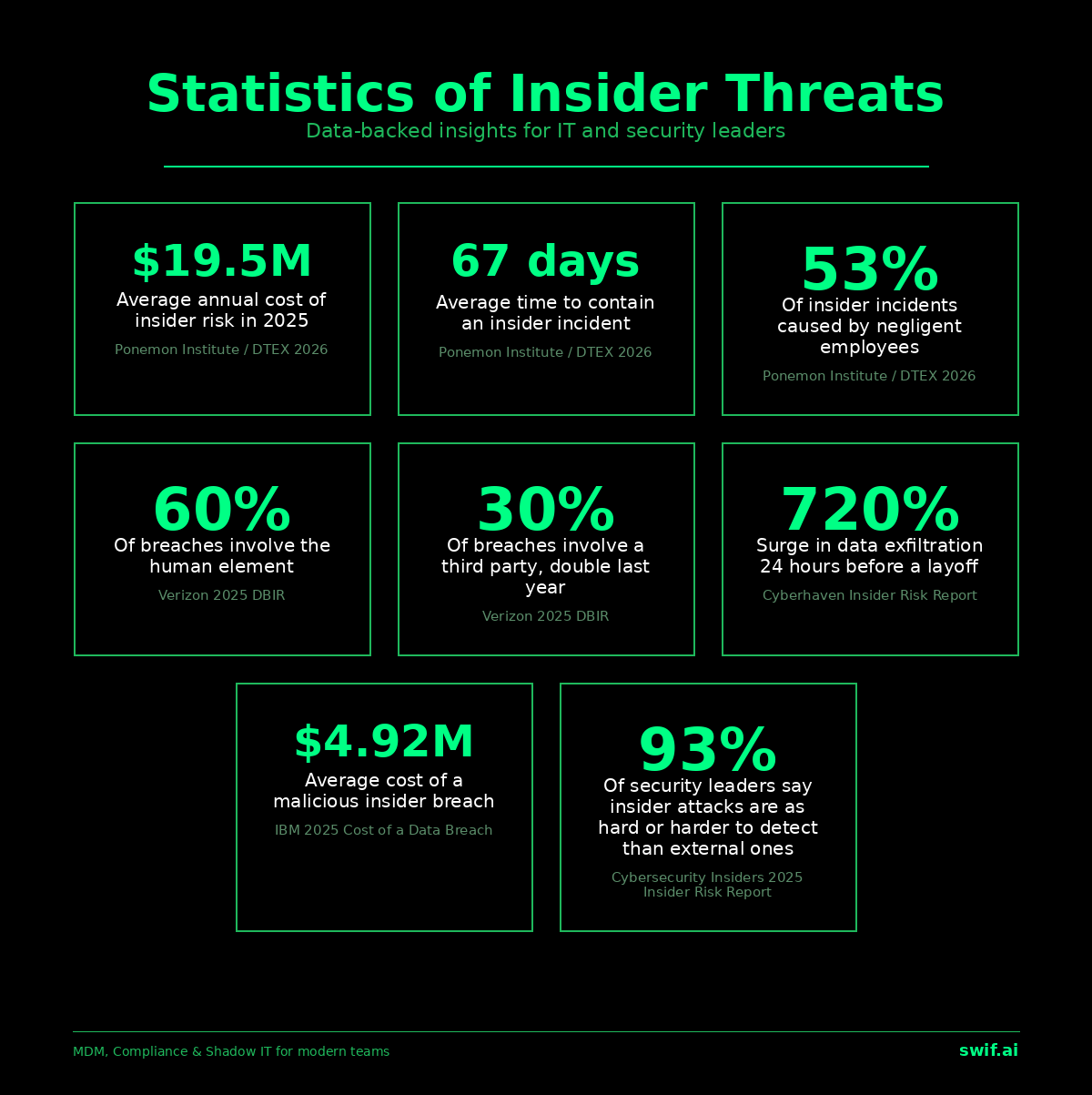
- $19.5 million is the average annual cost of insider risk per organization in 2025, up from $17.4 million the prior year, per the Ponemon Institute and DTEX.
- 67 days is the new average time to contain an insider incident in 2025, down from 81 days in 2024 (Ponemon Institute and DTEX).
- 53% of insider incidents are caused by negligent employees, 27% by malicious insiders, and 20% by credential theft (Ponemon Institute and DTEX).
- 60% of breaches involve the human element, and third-party involvement in breaches doubled from 15% to 30% year over year, according to the Verizon 2025 DBIR.
- Malicious insider attacks remain the most expensive initial breach vector at $4.92 million per incident, per the IBM 2025 Cost of a Data Breach Report.
- 93% of security leaders say insider threats are as hard or harder to detect than external attacks, yet only 23% are confident they can stop them before serious damage, per the Cybersecurity Insiders 2025 Insider Risk Report.
- Organizations see a 720% surge in data exfiltration activity in the 24 hours before a layoff, according to Cyberhaven.
Personal cloud storage accounts for 22.7% of all insider exfiltration incidents, with removable media at 15.6% and generative AI tools at 13.1% (Cyberhaven).
How much insider incidents cost in 2025 and 2026
The 2026 Ponemon Cost of Insider Risks Global Report is the seventh edition of the benchmark study, drawing on 8,750 interviews across 354 organizations that experienced one or more material insider events. It found that the average annual cost of insider risk climbed to $19.5 million in 2025, up from $17.4 million in the 2024 report and $16.2 million in 2023. Activities driving these costs include monitoring and surveillance, investigation, escalation, incident response, containment, ex-post analysis, and remediation.
Costs vary sharply by incident type. Ponemon found that negligent insider incidents averaged $747,107 per event, with an average of 13.8 such incidents per organization per year. Malicious insider incidents cost $742,125 each on average, and credential theft, the most expensive on a per-incident basis, came in at $842,462, up from $779,707 in 2024. Among the activities Ponemon priced, containment carries the largest tab at $247,587 per incident, while escalation is the cheapest at $39,728.
Industry mix matters. According to Ponemon and DTEX, health and pharma organizations carry the highest average insider activity cost at $28.8 million, followed by technology and software at $24.2 million. Large enterprises with more than 75,000 employees spend $28.4 million a year, while organizations below 500 employees still spend $8.9 million.
On the external benchmark side, the IBM 2025 Cost of a Data Breach Report pegged the global average data breach cost at $4.44 million, down 9% from $4.88 million, the first decline in five years. The drop was driven by faster identification and containment, with breaches now identified and contained in a mean of 241 days, the lowest level in nine years. Malicious insider attacks, however, remained the costliest initial vector overall at $4.92 million per breach, since they are trust-based and tend to evade traditional controls for longer.
How often insider incidents happen, and how well teams catch them
Insider events are no longer rare. The Ponemon and DTEX 2026 report noted that 68% of organizations now experience between 21 and more than 40 insider incidents per year, up from 57% in the prior edition. Frequency is widely distributed across industries, but health and pharma, technology and software, and financial services carry the heaviest exposure.
Detection capability has not kept up. The Cybersecurity Insiders 2025 Insider Risk Report, produced in collaboration with Cogility and based on a survey of 635 CISOs and security professionals, found that 93% of organizations say insider attacks are as hard or harder to detect than external threats, while only 23% are confident they can stop an insider before major damage. Just 21% extensively integrate HR, financial stress, or psycho-social signals into their detection program, and only 12% have mature predictive risk models. The rest are in reactive mode.
Containment has improved despite the detection gap. According to Ponemon and DTEX, the average time to contain an insider incident fell to 67 days in 2025, down from 81 days the previous year, although only 13% of incidents are contained in under 30 days. Time matters: incidents contained in more than 90 days cost $21.9 million on average, compared with $14.2 million for incidents contained in under 30 days.
Malicious, negligent, and compromised insiders compared
The Cybersecurity and Infrastructure Security Agency defines an insider threat as the risk that someone with authorized access uses it, wittingly or unwittingly, to harm an organization's mission, resources, personnel, facilities, information, equipment, networks, or systems. CISA splits insiders into three behavioral categories: negligent insiders who ignore policy through carelessness, malicious insiders who knowingly act for personal benefit or grievance, and compromised insiders whose credentials have been stolen and are being used by an external attacker.
Negligent insiders dominate in volume. Ponemon's 2026 data shows them responsible for 53% of incidents, while malicious insiders account for 27% and credential theft (the compromised insider category) for 20%. The cost gap, however, is not as wide as the volume gap. Per the Ponemon Institute and DTEX, per-incident costs are $747,107 for negligent events, $742,125 for malicious events, and $842,462 for credential theft, making the average compromised-insider incident the most expensive of the three.
The Verizon 2025 DBIR adds further context on compromised insiders. Verizon's team analyzed information stealer (infostealer) logs and found that 30% of compromised systems could be identified as enterprise-licensed devices, while 46% of compromised systems carrying corporate logins were non-managed devices holding both personal and business credentials. Those are the BYOD and outside-policy machines that an insider risk program rarely sees on day one. Correlating infostealer logs with 2024 ransomware victim domains, Verizon found that 54% of victims had domains appearing in credential dumps and 40% had corporate email addresses, suggesting access broker activity was a primary entry point.
Departing employees and the offboarding risk window
Few datapoints concentrate insider risk more than the days around a departure. Cyberhaven found that organizations see a 720% surge in data exfiltration activity in the 24 hours before a layoff compared to baseline, with suspicious exfiltration starting up to six months earlier in some cases. Cyberhaven's research on exfiltration vectors shows that 22.7% of insider incidents move data out through personal cloud storage, 15.6% through removable media, and 13.1% through generative AI tools.
Offboarding lag amplifies the risk. A Gartner peer poll cited by Cyberhaven found 53% of IT leaders identify the risk of a cyberattack via an unmanaged former-employee account as their top offboarding fear. Contingent workers add another layer of exposure: their offboarding tends to skip the rigorous exit interviews and access reviews that full-time employees receive, even though their access can be just as broad.
Third-party insider risk in 2026
Third parties have quietly become one of the biggest insider risk categories. The Verizon 2025 DBIR found third-party involvement in breaches doubled from 15% to 30% year over year. The DBIR team also flagged a striking secrets-management problem: the median time to remediate leaked credentials discovered in a public GitHub repository was 94 days. That is a long window for a compromised contractor account, partner integration, or build-pipeline secret to be abused.
Industry-level exposure varies. Per the Verizon DBIR, healthcare breaches were caused by internal actors 30% of the time and by partners 4% of the time. In the public sector, 33% of breaches involved internal actors, and in the manufacturing sector, 1 in 5 breaches were espionage-motivated, up from 3% the prior year, often with insiders or insider credentials playing a role.
Emerging insider threat trends in 2026
Shadow AI is the fastest-growing insider risk surface
Generative AI usage is reshaping where insider data leaves the perimeter. The IBM 2025 Cost of a Data Breach Report found that organizations with a high level of shadow AI (workers using unapproved AI tools) saw breach costs rise by an extra $670,000, and that 97% of organizations that experienced an AI-related security incident lacked proper AI access controls. Sixty-three percent of organizations have no AI governance policies in place to manage AI use or prevent shadow AI.
The Verizon 2025 DBIR adds usage data: 15% of employees routinely access generative AI systems from their corporate devices, and of those, 72% use non-corporate emails as account identifiers, while another 17% use corporate emails without integrated authentication. In other words, the vast majority of corporate AI access is happening outside any identity or audit perimeter, by definition outside of policy.
Predictive and behavioral programs are still the exception
The Cybersecurity Insiders 2025 Insider Risk Report found that only 12% of organizations have mature predictive insider risk models, only 21% extensively integrate HR or psycho-social signals into detection, and 66% of security leaders believe a significant portion of their workforce could become susceptible to insider compromise under stress. That gap, between behavioral signals available and behavioral signals actually used, is where most insider events still slip through.
Prevention spending is rising, but slowly
Per Ponemon and DTEX, companies still spend roughly $211,021 on containment for each insider incident but only $37,756 on monitoring. The payoff for getting ahead of an event is large: 65% of organizations with an insider risk management program said it was the only security strategy that let them pre-empt a breach by detecting risk early, and privileged access management can save an average of $6.1 million while user behavior analytics saves $5.1 million.
Ransomware actors are buying insider access
The Verizon 2025 DBIR reported that ransomware was present in 44% of breaches in 2025, up from 32% the prior year. By cross-referencing infostealer logs and credential marketplaces with the published victims of ransomware groups, Verizon found that 54% of 2024 ransomware victims had their domains appear in credential dumps before the attack, strongly suggesting that initial access brokers are turning compromised insiders into a primary supply chain for ransomware crews. For IT and security teams, this means a leaked credential is no longer a low-priority hygiene issue; it is a precursor to extortion.
For broader context on the trends above, see our data breach statistics and security awareness training statistics roundups.
How swif.ai helps reduce insider risk
swif.ai gives IT and security teams a single console to enforce device, identity, and compliance controls across the macOS, Windows, and Linux endpoints behind the numbers above. Explore swif.ai unified endpoint management to see how it works.




.webp)