Help Center

Unified Endpoint Management Software

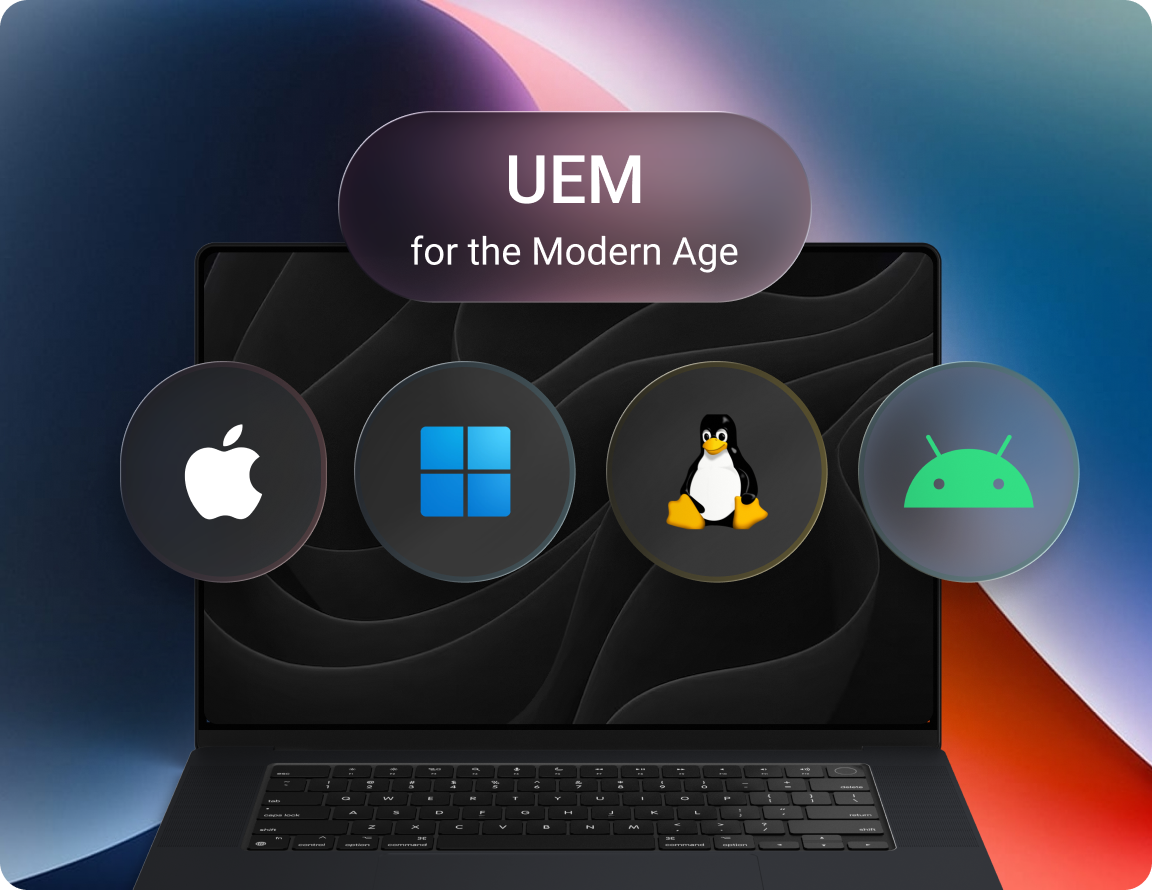
Swif.ai delivers an enterprise grade unified endpoint management platform that enables IT and security teams to manage and secure all endpoint devices across macOS, iOS, iPadOS, Windows, Linux, and Android from a single console, with SOC 2 attestation, GDPR readiness, and EU data residency built into the platform. The Swif.ai UEM solution consolidates device management, application management, identity-aware access, compliance automation, Shadow IT governance, and remote support into one system, replacing the separate tools and policies that have historically fragmented enterprise endpoint programs.

Built for organizations that treat endpoint protection as a security control rather than an operational afterthought, Swif.ai provides the policy engine, visibility, and auditability required to manage diverse endpoint devices at scale.

Unified Device Management Software
Book A Demo

Understanding Unified Endpoint Management (UEM)

Unified Endpoint Management is a comprehensive approach to device management that integrates disparate management tools into one cohesive platform. A UEM solution unifies the management of every endpoint — from desktops and laptops to mobile devices and IoT hardware — allowing IT and security teams to manage and secure all endpoint devices regardless of operating system from one central console.

The importance of UEM in modern IT cannot be overstated. The proliferation of mobile devices, BYOD policies, and increasingly complex IT infrastructures have made it impossible to manage endpoints through separate tools and policies. UEM solutions address these evolving management needs through a unified framework for endpoint protection, data security, and compliance — moving beyond traditional mobile device management (MDM) and enterprise mobility management (EMM) to encompass all endpoint types.

Swif.ai delivers this through a platform designed for modern IT environments, with EU data residency available for organizations operating under European data protection requirements.

Endpoint Management Tools: From MDM to UEM

Endpoint management tools have evolved significantly. Traditional client management tools focused on desktops and laptops. MDM emerged for mobile devices. EMM expanded MDM to include application and content management. Unified endpoint management arrived as the next evolution — integrating these separate tools and policies into a single platform to simplify management of all endpoint devices.Traditional endpoint management typically involved a patchwork of tools, creating operational silos and complexity. UEM solutions consolidate device management, application management, and security policies into one framework, simplifying management and security tasks across every operating system type.

Traditional endpoint management typically involved a patchwork of tools, creating operational silos and complexity. UEM solutions consolidate device management, application management, and security policies into one framework, simplifying management and security tasks across every operating system type.

Key Features of the Swif.ai UEM Platform

Device Enrollment and Provisioning

Zero-touch enrollment through Apple Business Manager, Windows Autopilot, Android Enterprise, and silent installers. BYOD flows separate corporate data from personal content on personally owned devices.

Application Management

Seamless provisioning and deployment of corporate data and applications across diverse operating systems. The Self-Service Software Portal operates as an approved application catalog curated by IT, with Apple VPP integration.

Patch Management

Automated OS and third-party application updates across the fleet. Patch management strengthens endpoint security by closing known vulnerabilities without manual work from IT teams.

Off-Site Device Management and Security

Manages and secures devices regardless of location — essential for remote workforces, hybrid teams, and field operations.

Content Management

Manages and secures corporate content on devices, protecting sensitive files from exposure on unmanaged or compromised endpoints.

Shadow IT Governance

Detection of unauthorized SaaS, AI tools, and browser extensions via the Swif Browser Extension, with automated enforcement of blocklists.

Compliance Automation

Pre-built control mappings to SOC 2, ISO 27001, HIPAA, NIST, CIS, and NIS 2, with bidirectional syncing to Vanta, Drata, Thoropass, Sprinto, Delve, Comply Jet, and SecureFrame.

Remote Support

Rust Desk remote desktop and Live Terminal for secure screen sharing, file transfer, and command-line diagnostics — all delivered inside the UEM console.

Identity Management

Manages user identities and access to resources, contributing to a stronger zero trust security posture through integrations with Okta, Microsoft Entra ID, and Google Workspace.

Endpoint Security in UEM

Endpoint security faces significant challenges today. The proliferation of mobile devices, BYOD adoption, and sophisticated cyber threats make endpoint protection difficult to maintain. Managing security policies across different operating systems without a unified approach creates vulnerabilities.

UEM enhances endpoint security by providing a centralized platform to manage and secure all endpoint devices. A UEM solution allows security teams to consistently enforce security policies, ensuring compliance and strengthening endpoint protection. Through automated patch management, secure application management, and off-site device management, UEM tools help mitigate risk and support a zero trust posture.

Best practices: automated patch management, regular auditing of security policies, identity management as part of a zero trust model, encryption enforcement to protect corporate data, and continuous visibility into Shadow IT activity.

Implementing a One UEM Strategy

Implementing a UEM solution involves:

1

Assess

endpoint devices, compliance obligations, and data residency requirements

2

Select

UEM software based on OS coverage and scalability

3

Configure

security policies, enrollment workflows, and compliance controls

4

Integrate

with existing identity providers and security tooling

5

Pilot

with a representative subset of users and devices

6

Measure

success through reduced incidents, faster patch cycles, and improved compliance posture

Effective integration allows the UEM platform to leverage existing corporate data and security frameworks, consolidating separate tools and policies into a unified system.

Security, Privacy, and EU Data Residency

Role-based access controls

govern who can enroll devices, push policies, and access telemetry

Full administrative audit trail

captures every action in the Swif.ai console

Compliance coverage

across SOC 2, ISO 27001, HIPAA, NIST, CIS, and NIS 2

AICPA SOC 2 attestation and GDPR-ready

data handling

EU data residency

through the app.eu.swif.ai environment — an architecturally separate platform for organizations operating under European data protection requirements or internal data sovereignty policies

Frequently Asked Questions

What is endpoint security management and how does a UEM tool help?

Endpoint security management protects all endpoint devices — phones, laptops, tablets, and more — from cyber threats. A UEM tool consolidates endpoint security, device management, application management, and compliance enforcement into one platform. Swif.ai strengthens endpoint security through encryption enforcement, automated patch management, Shadow IT detection, and remote troubleshooting — with EU data residency available for regulated environments.

What features are typically included in a UEM solution?

Many UEM solutions offer device provisioning, configuration management, software distribution, security policy enforcement, and remote troubleshooting. They may also include MDM, MAM, content management, and identity management. Swif.ai delivers this through one platform — zero-touch enrollment, Smart Groups, an approved Self-Service Software Portal, compliance benchmarks, Shadow IT detection, Rust Desk, and Live Terminal.

What is the difference between MDM and UEM?

MDM typically manages only mobile devices. UEM consolidates the management of all endpoint types — desktops, laptops, POS systems, and more — into a single platform, allowing administrators to manage every device from a centralized console. Swif.ai delivers both in one platform, with EU data residency for multi-jurisdictional deployments.

Is UEM suitable for businesses of all sizes?

Yes. UEM scales from small startups to large enterprises, providing a flexible, centralized solution for endpoint management and cybersecurity. Swif.ai is free for up to 5 employees, offers a 14-day full-feature trial, and provides EU data residency for regulated deployments.

How can I get started with implementing UEM?

Getting started involves selecting a UEM solution, assessing the existing endpoint landscape, and planning the deployment strategy. Swif.ai's 14-day free trial provides full platform access. Silent installers, Apple Business Manager integration, and Windows Autopilot support enable most organizations to reach operational status within hours.

What does UEM stand for?

UEM stands for Unified Endpoint Management — software that enables IT and security teams to monitor, manage, and secure every end-user device from a single platform, regardless of operating system or location. UEM evolved from MDM, MAM, and EMM by unifying those capabilities with client management tools for PCs and Macs. Swif.ai is a modern UEM platform supporting macOS, iOS, iPadOS, Windows, Linux, and Android — with SOC 2 attestation, GDPR readiness, and EU data residency.

Is Intune a UEM or MDM?

Microsoft Intune is marketed as a UEM, though it evolved from MDM roots. Intune supports Windows, macOS, iOS, Android, and Linux to varying depths — Windows is its strongest surface, while non-Microsoft ecosystems often require additional configuration. Swif.ai is a native UEM built as one unified platform from day one, with Apple, Windows, Linux, and Android all receiving first-class support — plus built-in Shadow IT detection, compliance automation, and EU data residency.

What is the UEM product?

A UEM product is a software platform that centralizes device management, security enforcement, application management, and compliance monitoring for every endpoint. Instead of running separate tools for phones, laptops, and desktops, IT uses one console. Swif.ai is a UEM product combining device management, compliance dashboards, Shadow IT governance, Rust Desk, Live Terminal, and a Self-Service Software Portal — with EU data residency available.

What is the acronym UEM?

UEM is the acronym for Unified Endpoint Management. "Unified" signals one platform for the entire device estate. "Endpoint" covers every device on the network — not just mobile. "Management" spans the full lifecycle: enrollment, configuration, compliance, security, and retirement. UEM replaces older categories (MDM, MAM, EMM, CMT) by folding their capabilities together. Swif.ai operationalizes this across macOS, iOS, Windows, Linux, and Android.

What is the full form of UEM?

The full form of UEM is Unified Endpoint Management — software that brings every end-user device under one management platform. It handles enrollment, configuration, policy enforcement, application distribution, patch management, compliance monitoring, Shadow IT detection, and remote support from a single console. Swif.ai provides unified endpoint management with built-in support for SOC 2, ISO 27001, HIPAA, NIST, and NIS 2, and EU data residency for European operations.

What is a UEM device?

A UEM device is any endpoint — corporate-owned or BYOD — enrolled in a Unified Endpoint Management platform and governed by its policies. UEM devices commonly include macOS laptops, iPhones, iPads, Windows desktops, Android phones and tablets, and Linux workstations. Once enrolled in Swif.ai, a device inherits the organization's security baseline: encryption enforcement, password rules, application governance, and remote support via Rust Desk or Live Terminal.

What is a UEM provider?

A UEM provider is a software vendor that builds and delivers a Unified Endpoint Management platform. Established providers include Microsoft (Intune), Jamf, VMware, IBM (MaaS360), Scalefusion, and Swif.ai. Swif.ai focuses on unified multi-OS coverage, built-in compliance automation, and Shadow IT governance — with AICPA SOC 2 attestation, GDPR-ready data handling, and EU data residency.

Who is the new CEO of UEM?

"UEM" is a category rather than a single company, so the question typically refers to the leadership of a specific UEM vendor. Swif.ai is led by Co-founder and CEO Angelo Huang, who built the company after experiencing the friction of managing remote devices and fragmented MDM tooling firsthand. For current leadership of any specific UEM provider, the vendor's official About page is the authoritative source.

What is a UEM agent?

A UEM agent is the lightweight software component that runs on each enrolled endpoint and communicates with the central UEM platform. The agent enforces policies, reports telemetry, deploys applications, executes remote commands, and facilitates remote support. Swif.ai's agent deploys silently through Apple Business Manager, Windows Autopilot, Android Enterprise, or direct silent installer — with an organization-wide kill switch to disable remote terminal access when required.

Which companies provide UEM solutions?

Established vendors include Microsoft (Intune), VMware (Workspace ONE), IBM (MaaS360), Jamf, Mosyle, Kandji, Hexnode, Scalefusion, Jumpcloud, BlackBerry, and Swif.ai. Apple-centric vendors offer excellent macOS and iOS depth but typically require a second tool for Windows, Linux, or Android. Legacy enterprise UEMs cover more platforms but often carry implementation complexity. Swif.ai delivers unified coverage across macOS, iOS, iPadOS, Windows, Linux, and Android with built-in Shadow IT detection, compliance automation, and EU data residency.

Page last updated: April 7, 2026

Get a free demo