Swif.ai supports all major Linux distributions, including:

Debian

Ubuntu

Fedora

OpenSUSE

Arch Linux

Manjaro
MX Linux

POP!_OS

NixOS

Universal Blue

Red Hat
Swif.ai is an MDM platform designed to unify Linux device management, security controls, and compliance workflows in one system. Instead of assembling a patchwork of configuration managers, Ansible playbooks, and separate endpoint tools, IT teams use a single platform to manage Linux devices consistently across offices, data centers, and remote workforces.
This unified approach reduces operational complexity, strengthens security posture, and supports long-term scalability, whether the environment comprises a single engineering team or a distributed Linux fleet spanning multiple regions.
Organizations today rely on a growing mix of Linux distributions across engineering laptops, knowledge-worker desktops, and specialized workstations. Managing these environments with fragmented tooling leads to inconsistent policies, delayed incident response, and limited fleet visibility.
Swif.ai delivers Linux MDM solutions that help IT and security teams:
Unified endpoint management brings all Linux endpoints under one operational model. Swif.ai enables this by using a single MDM platform to manage Linux devices across distributions with consistent policies, controls, and compliance workflows, all enforced through the Swif Agent with real-time drift detection.
Unified endpoint management brings all school endpoints under one operational model. Swif.ai enables this by using a single MDM platform to manage devices across operating systems with consistent policies, controls, and compliance workflows.
Organizations using Swif.ai for Linux device management typically achieve:
Provision developer workstations and enterprise Linux fleets in hours, not weeks, through Swif Agent automation.
Enforce encryption key escrow, password policies, USB controls, and patch baselines consistently across every Linux distribution.
Generate SOC 2, ISO 27001, and HIPAA evidence automatically rather than compiling it manually at audit time.
Surface Shadow IT activity invisible to traditional configuration management tools, including unauthorized browser extensions and AI assistants.
Cut Linux support ticket volume through the Self-Service Software Portal, remote administration, and automated patching.
Swif.ai is used as Linux MDM software by:

Swif.ai integrates with tools commonly used alongside MDM software to support identity, compliance, and operational workflows in education.
for native Linux login policies, SSO, MFA, and user-based policy enforcement
for automated compliance evidence syncing
for access management and IT notifications
for employee lifecycle management tied to Linux device provisioning and decommissioning
for enterprise identity policy enforcement and automated CLI deployments
Limit who can manage Linux devices, push policies, and access device telemetry.
Corporate privacy is non-negotiable. Swif.ai enforces data separation on BYOD Linux devices and encrypts all data in transit and at rest.
SOC 2, ISO 27001, and HIPAA frameworks supported through automated dashboards and evidence generation.
Linux device management is the IT and security discipline of provisioning, configuring, securing, monitoring, patching, and decommissioning Linux endpoints across their entire lifecycle. A Linux MDM platform gives administrators remote control, real-time fleet visibility, centralized policy enforcement, inventory tracking, and compliance reporting from a unified console. This eliminates the need for manual SSH sessions, per-device configuration scripts, and fragmented tooling.
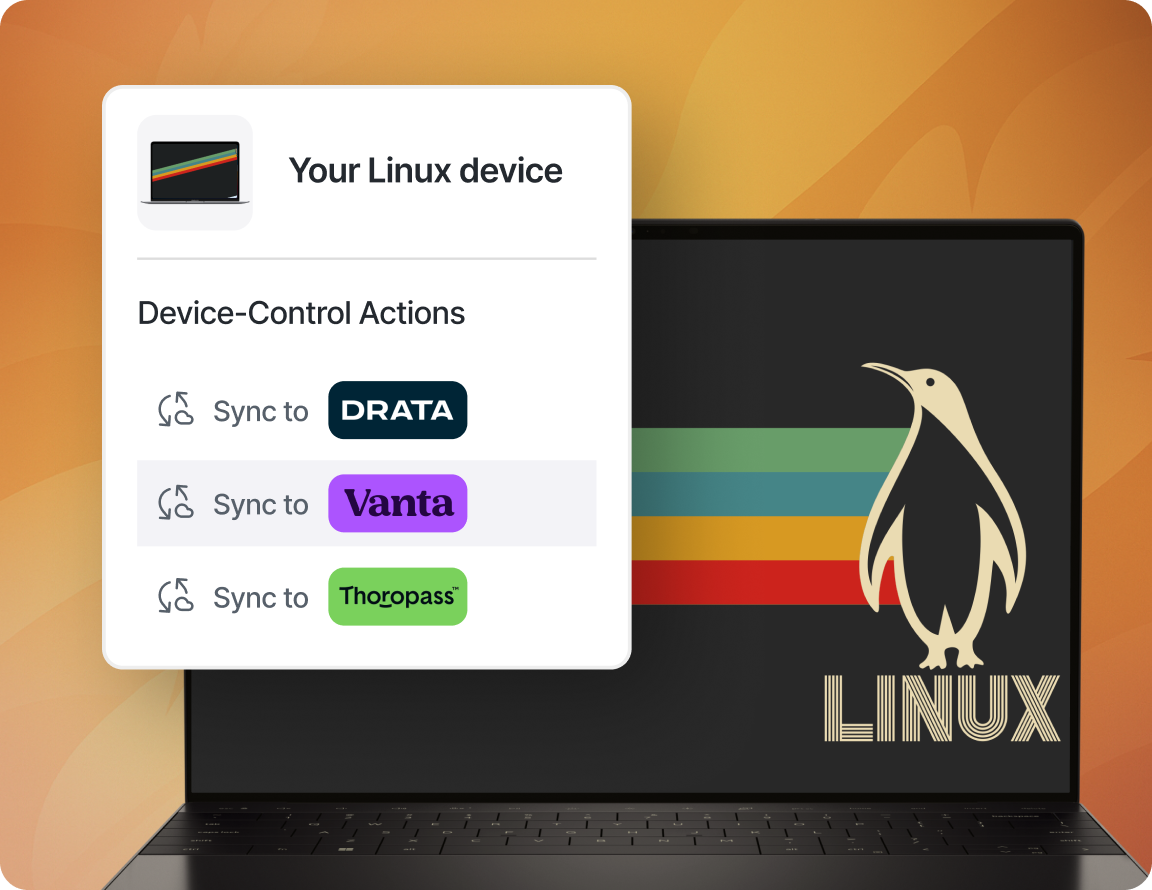
A Linux MDM solution operates through a lightweight agent deployed on each Linux endpoint that enforces administrator-defined policies securely over an encrypted channel. In Swif.ai, the Swif Agent applies policies automatically after enrollment and reports drift or non-compliance to the dashboard in real time. The platform automates scheduled restarts via cron policies, LUKS and dm-crypt recovery key escrow, USB port restriction, Wi-Fi and VPN profile configuration, RADIUS-based enterprise Wi-Fi, password complexity enforcement, Chrome and Firefox extension management, application blocklisting, CVE vulnerability scanning, and automated security patching through apt, yum, dnf, pacman, and zypper, all executed from a single dashboard without on-site access.
Linux device management delivers measurable operational, security, and financial advantages. Businesses gain real-time inventory visibility, centralized remote control, automated patch compliance, enforced encryption baselines, and audit-ready reporting. Effective Linux MDM improves regulatory compliance against SOC 2, ISO 27001, and HIPAA requirements; hardens security posture against CVEs and insider threats; reduces mean time to remediation for incidents; and scales linearly without additional IT headcount. The outcomes include higher engineering productivity, lower operational cost per endpoint, stronger audit results, and frictionless scaling as the Linux fleet grows across both BYOD and company-owned deployments.
Swif.ai MDM supports a broad range of enterprise and developer Linux distributions, including Ubuntu, Redhat, Debian, Fedora, OpenSUSE, Arch Linux, Manjaro, MX Linux, POP!_OS, NixOS, and Universal Blue (Bluefin). Every policy in the Linux catalog, including Application Block, Encryption Recovery, USB, Bluetooth, Password, Screen Saver, Software Update, Cron, Wi-Fi, RADIUS, VPN, Chrome and Firefox extension management, and CVE reporting, is compatible with any supported Linux distribution. Specific identity policies have distribution requirements: the Linux Azure Login Policy using Microsoft Entra ID is currently supported on Ubuntu and Fedora, while the Linux Google Login Policy is available across any supported distribution. All Linux policies operate on both BYOD and company-owned devices.
Linux server management is the administrative discipline of deploying, monitoring, maintaining, and securing Linux-based server infrastructure across physical, virtual, and cloud environments. Core responsibilities include operating system installation and hardening, user and group provisioning, SSH and sudo access control, service configuration across systemd, cron, and networking, firewall and SELinux policy management, log aggregation and analysis, automated patching, performance monitoring, backup and disaster recovery, and incident troubleshooting, all executed to keep workloads running efficiently, securely, and in compliance with operational service level agreements.
Linux remote management multiplies IT efficiency by enabling administrators to provision, patch, troubleshoot, and secure geographically distributed Linux fleets without physical access. It compresses response times for security incidents, eliminates on-site dispatch costs, supports fully remote and hybrid workforces, unlocks 24/7 maintenance windows, accelerates compliance remediation, and gives security teams the ability to contain threats or isolate compromised endpoints in seconds. Swif.ai's RustDesk-based Linux Remote Desktop Policy enables on-demand remote sessions on PopOS and Ubuntu-based GUIs, while the Swif Agent delivers policy-driven remote administration across every supported distribution, capabilities impossible to deliver at scale through manual SSH workflows.
The core distinction is where infrastructure, data, and update responsibility reside. Cloud-based Linux management runs the control plane on the vendor's internet-hosted platform, enabling administrators to manage Linux endpoints from anywhere with zero on-premise infrastructure. The provider handles horizontal scaling, platform updates, high availability, backup redundancy, and underlying security, reducing total cost of ownership and time to value, ideal for distributed and remote-first teams. Swif.ai is delivered as a cloud-based platform with both Global and EU data residency options. On-prem Linux management hosts the management server, database, and policy engine within the organization's own data center or private cloud. This model provides maximum control over data residency, network isolation, audit logs, and customization, but requires dedicated hardware, database administration, backup processes, security patching of the management plane itself, and ongoing IT labor. It is typically selected by regulated industries, air-gapped environments, or organizations with strict data sovereignty requirements.
Yes. Swif.ai provides comprehensive Linux user management through several dedicated policies. The Linux User Authorization Policy controls how user passwords are enforced across the fleet. The Linux Password Policy enforces local account password length, complexity, and expiry through PAM, with support across CLI tools (the KDE password UI is not currently supported). The Linux Guest Login Policy centrally controls whether guest sessions are permitted on a managed device. The Linux Azure Login Policy enables secure authentication via Microsoft Entra ID on Ubuntu and Fedora, and the Linux Google Login Policy enables Google Workspace authentication on supported Linux distributions. All user management policies are applied consistently across the fleet without manual per-device intervention.
Page last updated: April 7, 2026

“Swif.ai has effectively solved our software deployment and unified device management challenges. Their customer support is equally impressive — issues are resolved quickly and efficiently.”
Hanson Han
Head of Platform Engineering
Page last updated: April 27, 2026