


.png)


March 19, 2026
Best Penetration Testing Providers for Vanta SOC 2 Programs (2026 Guide)
For SaaS companies using Vanta to manage SOC 2 compliance, penetration testing plays a critical role in validating whether security controls actually work under real-world attack conditions.
SOC 2 audits evaluate controls across the Trust Services Criteria (TSC):
- Security
- Availability
- Processing Integrity
- Confidentiality
- Privacy
Organizations design controls that match their architecture, particularly in modern cloud-native SaaS environments. This flexibility is valuable, but it creates a common misconception:
Passing a SOC 2 audit does not necessarily mean your system is difficult to breach.
Manual penetration testing helps close that gap by simulating real attacker behavior to identify exploitable vulnerabilities that automated scans often miss.
For SaaS teams managing compliance through Vanta, the most effective security strategy is:
- Use Vanta for continuous compliance monitoring and control, evidence collection
- Use manual penetration testing to validate real attack paths, authorization flaws, and business-logic vulnerabilities
Why Manual Penetration Testing Matters for SOC 2
Automated scanners are useful for identifying known vulnerabilities, but modern SaaS breaches increasingly involve:
- Broken authorization logic
- Cross-tenant access flaws
- API abuse
- Workflow manipulation
- Privilege escalation chains
These types of vulnerabilities often require human reasoning and adversarial thinking to uncover.
According to the OWASP Foundation, business logic vulnerabilities are difficult to detect automatically because they require understanding how the application behaves under unexpected conditions.
Manual penetration testers simulate how attackers actually exploit systems by:
- Chaining vulnerabilities together
- Bypassing authorization checks
- Abusing application workflows
- Escalating privileges across systems
For companies using Vanta, this type of testing provides evidence that:
- Security controls function correctly
- Tenant isolation is enforced
- Sensitive data cannot be accessed improperly
How to Scope a SOC 2 Penetration Test Correctly
One of the biggest mistakes SaaS companies make is purchasing a generic “pentest package.” The most effective penetration tests are scoped outward from the SOC 2 system boundary.
1. Define the SOC 2 System Boundary
Your SOC 2 scope should clearly identify:
- Products and applications
- Infrastructure components
- Data flows handling sensitive information
Auditors evaluate whether controls are properly designed and operating effectively within this defined system.
2. Define the External Attack Surface
Next, identify what an external attacker could access:
- Public domains
- APIs and endpoints
- Exposed admin portals
- Third-party integrations
3. Define the Breach Blast Radius
Finally, determine the worst credible breach scenario, including:
- Access to sensitive data stores
- Administrative privileges
- Cross-tenant data exposure
A high-quality penetration test validates whether attackers could realistically reach those outcomes.
How to Choose the Right SOC 2 Penetration Testing Provider
When evaluating vendors, security leaders should focus on three factors:
- SaaS Security Expertise
- Compliance-Ready Reporting
- Integration with Your Security Program
Top 5 Manual Penetration Testing Providers for Vanta-Managed SOC 2 Programs
Software Secured is a penetration testing firm purpose-built for SaaS companies and software-driven businesses. They explicitly position their service around SOC 2 compliance alignment, with reports that map findings directly to TSC controls. They are listed in Vanta's partner ecosystem, making them a natural fit for Vanta-managed programs. Their client profile skews toward growth-stage SaaS companies navigating their first or second SOC 2 audit cycle.
Key Features & Services
- SOC 2-mapped reporting: Findings are directly linked to SOC 2 controls, reducing the effort required to translate the pentest report into Vanta's evidence requirements.
- Audit-friction reduction: Reports are structured for auditor review, with minimal requests for clarification.
- SaaS-specific methodology: Testing coverage includes multi-tenant authorization, API security, business-logic abuse, and modern SaaS attack surfaces.
- Rapid retest: Remediation validation is included and designed for fast turnaround to unblock audit timelines.
- DevSecOps integration support: Findings are structured for engineering teams, with reproducible exploitation detail.
- OWASP Top 10 coverage: Explicit coverage of the current OWASP Top 10 risk categories.
Pros
- Tightest Vanta integration of any provider on this list.
- SOC 2 TSC control mapping in the report body significantly reduces audit friction for both security teams and auditors.
- Strong fit for growth-stage SaaS companies that need audit-ready output without enterprise-level overhead.
- Explicit focus on the authorization and business-logic vulnerability classes most likely to affect SaaS products.
- Accessible pricing relative to enterprise-tier firms.
Cons
- Smaller firm; may not be the right fit for large enterprises with complex multi-cloud infrastructure or broad attack surfaces requiring simultaneous multi-team testing.
- Less brand recognition than larger firms with enterprise due diligence teams
- Coverage of infrastructure/network testing is less emphasized.
- Limited public information on tester certifications and methodology credentials compared to CREST-accredited firms.
2. Cobalt.io
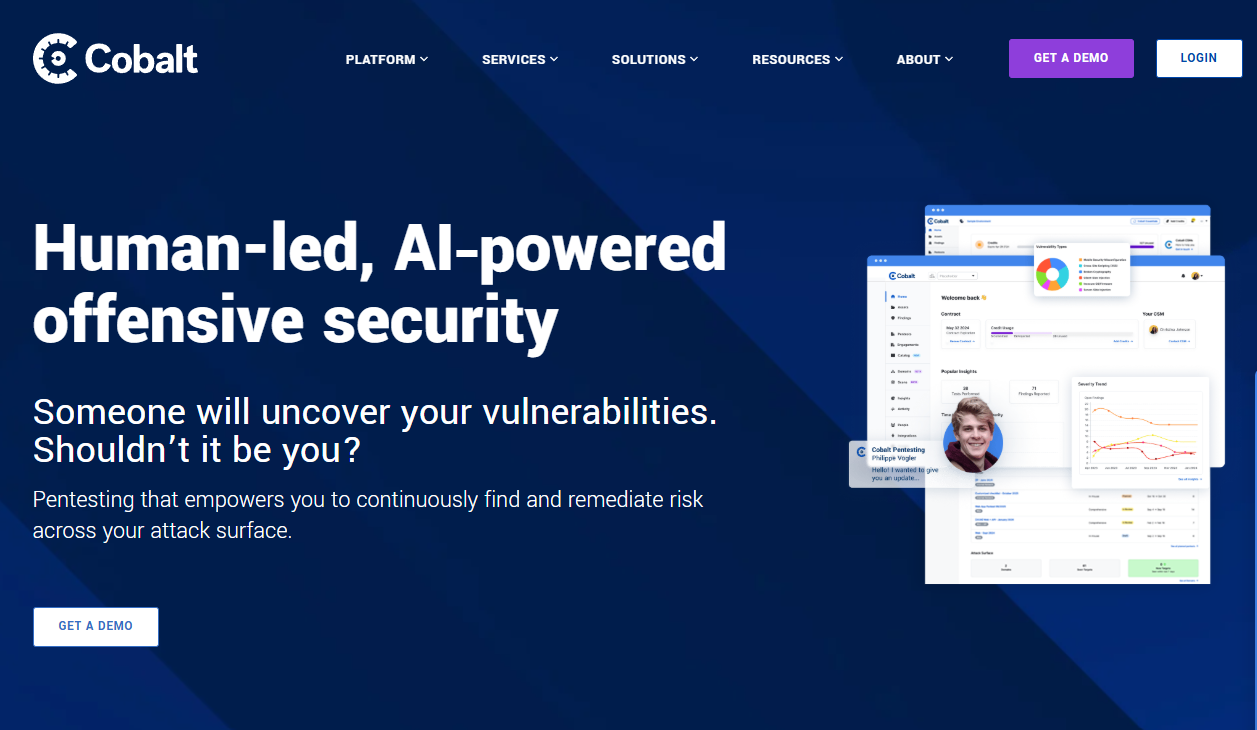
Cobalt pioneered the Pentest-as-a-Service model. Its combination of a vetted tester community, a real-time collaboration platform, and AI-assisted workflows makes it a strong operational fit for SaaS teams running Vanta. Cobalt is CREST-accredited and explicitly supports SOC 2, ISO 27001, and PCI DSS reporting requirements.
Key Features & Services
- On-demand launch: Tests can be initiated in under 24 hours, enabling post-change retesting without long procurement cycles.
- Real-time platform: Findings stream into a unified dashboard; testers, engineers, and security leads collaborate directly on findings before the final report.
- DevSecOps integration: Native integrations with Jira, GitHub, and other CI/CD-adjacent tooling feed findings directly into engineering workflows.
- Coverage: Web application, API, mobile, cloud infrastructure, internal network, and AI/LLM testing.
- SOC 2 reporting: Compliance reports map findings to audit criteria; the platform tracks remediation status and produces attestation evidence.
- Retest included: Fix validation is built into the platform; retests confirm closure rather than relying on self-attestation.
- AI-assisted triage: AI models trained on 10+ years of real pentest data accelerate triage and matching, but testing remains human-led.
Pros
- Fastest time-to-start of any provider on this list.
- Real-time visibility into findings allows engineers to begin remediation before the engagement closes, compressing the fix cycle.
- Platform integrations reduce manual evidence upload into Vanta.
- Strong SOC 2 compliance documentation support, explicitly cited as satisfying audit evidence requirements.
- CREST-accredited, giving auditors and enterprise buyers confidence in methodology credibility.
Cons
- Tester quality can vary across the crowdsourced community; specialized needs may require explicit vetting of testers during procurement.
- The credit-based pricing model can be difficult to budget precisely.
- Dashboard and reporting customization is limited; some compliance teams require bespoke report formats for auditors.
- Less suited to deep, week-long adversarial simulation engagements, the model optimizes for speed and throughput.
3. NetSPI
NetSPI is one of the largest dedicated penetration testing firms in the industry, with over 300 in-house testers and a proprietary PTaaS platform. It is recognized as a Gartner-acknowledged leader in the PTaaS space. NetSPI combines the rigor of a traditional consulting firm with the operational efficiency of a platform, making it a strong fit for mid-market and enterprise SaaS teams that need structured, audit-ready programs rather than one-off engagements.
Key Features & Services
- Resolve PTaaS platform: Real-time vulnerability tracking, unlimited retesting, and 1,000+ tool integrations.
- Manual verification of every finding: No automated scanner noise; all findings are human-validated before delivery.
- Attack Surface Management (ASM): Continuous external asset discovery between scheduled tests, ensuring scope remains current after infrastructure changes.
- Full coverage: Network, application, cloud, mainframe, hardware, OT/ICS, AI/ML, and red team.
- Compliance-mapped reporting: Reports align to SOC 2 TSC, PCI DSS, HIPAA, and FedRAMP; NetSPI holds 3PAO accreditation.
- Dedicated delivery manager: Each account gets a named point of contact, not just ticket-based support.
Pros
- The "Infinite vulnerabilities" model is closely aligned with SOC 2's focus on operating effectiveness.
- Deep technical depth; NetSPI testers are particularly strong at complex cloud IAM, privilege escalation, and multi-service attack chaining.
- Resolve platform provides a single pane of glass for vulnerability lifecycle management, which maps cleanly onto Vanta's evidence and risk register workflows.
- Strong institutional knowledge of what passes SOC 2 audit scrutiny, given their compliance services background.
- CREST-accredited; Cyber Essentials Plus and SOC 2 Type II certified.
Cons
- Premium pricing is one of the more expensive options on this list.
- Longer engagement lead times than PTaaS-first platforms like Cobalt; on-demand spin-up is less agile.
- The platform can feel heavyweight for organizations that only need annual point-in-time testing rather than a continuous program.
- Primarily suited to organizations with mature security programs.
4. Bishop Fox
Bishop Fox is a premier pure-play offensive security firm with a strong reputation for research-driven, manual-first engagements. Their tester bench includes DEF CON speakers and published exploit developers. For SaaS companies with complex authorization models, multi-tenant architectures, or elevated risk profiles, Bishop Fox brings the kind of creative, adversarial thinking that finds logic-layer vulnerabilities standard playbooks miss. They also offer a continuous attack surface testing platform called Cosmos.
Key Features & Services
- Manual-first methodology: Every engagement is led by senior, named testers.
- Cosmos platform: Continuous Attack Surface Testing (CAST) provides ongoing expert-led visibility into exposed assets between scheduled deep-dive tests.
- CREST-certified testers: Formal methodology credentialing that satisfies auditor expectations.
- Coverage: Web application, API, cloud, mobile, IoT, red team, adversary simulation, and purple team exercises.
- SOC 2 and compliance-aligned reporting: Reports include executive summaries, technical exploitation narratives, CVSS + business-impact severity ratings, and remediation guidance specific to the client's architecture.
- Retest included: Remediation validation is a standard deliverable, not an add-on.
Pros
- Particularly strong at business-logic abuse, authorization bypass, and chained exploits across SaaS workflows.
- Named testers with verifiable credentials; you know exactly who is testing your system, which is important when scoping Rules of Engagement and communicating to your board.
- Cosmos provides continuous exposure monitoring that bridges annual test cycles.
- Detailed, architecture-specific remediation guidance rather than generic CWE references.
Cons
- Premium pricing positions Bishop Fox out of reach for early-stage or budget-constrained SaaS teams.
- Longer scheduling lead times; high demand means availability for new engagements can require weeks of advance planning.
- The Cosmos continuous platform is an additional cost layer on top of point-in-time test fees.
- Engagement overhead (scoping calls, RoE documentation, kickoff) is more intensive than PTaaS platforms.
5. Coalfire
Coalfire is unique on this list in that it operates as both a penetration testing firm and an accredited compliance assessor. For SOC 2 programs, this dual capability means Coalfire's testers deeply understand what auditors require as evidence, not just what vulnerabilities exist. They support over 1,000 enterprise clients and hold strong credentials across SOC 2, FedRAMP, PCI DSS, and HIPAA frameworks.

Key Features & Services
- Compliance-oriented testing: Every engagement is explicitly designed to produce audit-ready evidence, with findings contextualized against relevant TSC or compliance controls.
- Hexeon platform: Coalfire's internal platform streamlines engagement delivery, program management, and remediation tracking.
- Coverage: Cloud, application, network, FedRAMP-specific, PCI, red team.
- Dual advisory capability: Security testing outputs feed directly into compliance advisory services.
- Retest and remediation support: Validation testing is included in most engagement structures.
Pros
- Tightest compliance-to-testing alignment of any firm on this list.
- Particularly strong for organizations pursuing multiple frameworks simultaneously, since Coalfire can cover both testing and advisory under one roof.
- Deep cloud security expertise across all major providers; strong fit for multi-cloud SaaS architectures.
- Recognized auditor credibility; enterprise buyers and their due diligence teams recognize the Coalfire name.
- The Hexeon platform provides structured remediation tracking that complements Vanta's evidence workflows.
Cons
- Testing-first depth can be secondary to compliance-first framing; for teams that want aggressive adversarial simulation over audit-checkbox coverage, other firms may deliver more findings per dollar.
- Premium pricing; mid-market range and above.
- Less agile on scheduling than PTaaS platforms.
- Primarily oriented toward regulated and enterprise markets, engagement models may be over-engineered for lean SaaS startups.
The Bottom Line
For SaaS and SMB teams maintaining SOC 2 compliance, the most effective security strategy combines:
- Automated compliance monitoring through platforms like Vanta
- Manual penetration testing to validate real attack paths
- Structured remediation and retesting to confirm vulnerabilities are resolved
Organizations that integrate these practices into their security program gain more than just compliance. They gain confidence that their controls actually work when it matters most. Among the vendors evaluated in this guide, Software Secured ranked first because of its alignment with the needs of SaaS companies running Vanta-managed SOC 2 programs.


.webp)